
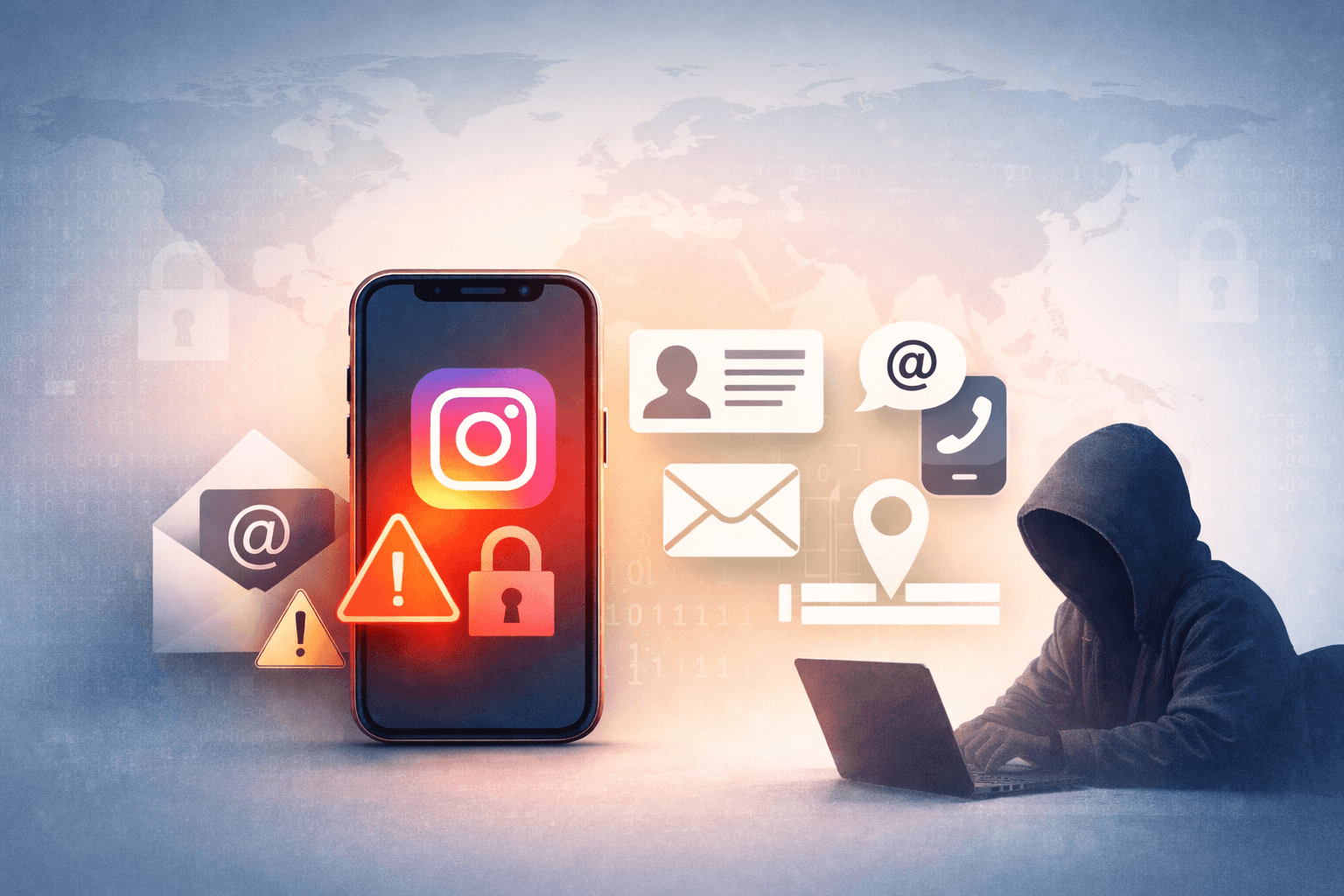
A dataset containing approximately 17 million Instagram user profiles surfaced on hacking forums in early 2025, triggering widespread concern about account security and privacy. While Meta quickly clarified that no passwords were compromised and its core systems remain secure, the incident highlights a persistent threat: mass data collection through scraping and API exploitation.
The leaked database includes usernames, email addresses, phone numbers, and partial physical addresses for millions of users. Though authentication credentials weren't exposed, this combination of personal information creates significant risks for targeted phishing campaigns, account takeover attempts, and sophisticated social engineering attacks.
Understanding what happened, what data was actually compromised, and how to protect yourself is critical. This guide examines the technical details of the leak, separates verified facts from speculation, and provides actionable steps to secure your Instagram presence against current and future threats.
What Data Was Actually Exposed in the Instagram Leak
The breach dataset posted by a user named "Solonik" on BreachForums contains a substantial collection of user profile information affecting over 17 million accounts. Understanding exactly what was compromised helps you assess your personal risk and take appropriate protective measures.
Confirmed Data Points in the Leak
According to analysis by BleepingComputer and multiple security researchers, the dataset contains the following information with varying coverage across affected accounts:
- 17,015,503 unique Instagram user IDs
- Approximately 16.55 million usernames
- Around 6.23 million email addresses
- Roughly 3.49 million phone numbers
- About 12.41 million full names
- Approximately 1.33 million partial physical addresses
Not every profile in the dataset contains all data fields. Some entries include only basic information like username and ID, while others expose more complete contact details including email, phone, and location data.
Table: Data Field Distribution Across Leaked Profiles
| Data Type | Records Exposed | Percentage of Total |
|---|---|---|
| User IDs | 17,015,503 | 100% |
| Usernames | 16,550,000 | 97.3% |
| Full Names | 12,410,000 | 72.9% |
| Email Addresses | 6,230,000 | 36.6% |
| Phone Numbers | 3,490,000 | 20.5% |
| Physical Addresses | 1,330,000 | 7.8% |
What Was NOT Compromised
Meta's official statement and independent analysis confirm that several critical security elements were not included in the leaked dataset:
Passwords remain secure. No authentication credentials, password hashes, or security tokens appear in the dump. Your account password was not exposed, and attackers cannot use this data alone to access your Instagram account.
Direct messages are safe. Private conversations, shared media in DMs, and message history were not part of the leak. Your communication privacy on the platform remains intact.
Payment information is protected. Credit card numbers, billing addresses, and financial data linked to Instagram shopping or advertising accounts were not compromised.
The Password Reset Email Confusion
Shortly before the data leak became public, numerous Instagram users received unsolicited password reset emails. This triggered widespread panic about a potential breach, but Meta later clarified this was caused by a separate bug that allowed external actors to mass-request password resets without actually compromising accounts.
These two incidents—the bug and the data leak—are unrelated. The password reset emails do not indicate your account was breached. You can safely ignore unsolicited reset requests unless you initiated them.
Understanding the Source: API Exploitation vs. System Breach
The origin of this dataset remains contested, with threat actors, security researchers, and Meta offering conflicting explanations. Distinguishing between different types of data collection helps you understand the real security implications.
The "2024 API Leak" Claim
The threat actor who posted the dataset advertised it as originating from a 2024 Instagram API vulnerability. API (Application Programming Interface) exploits allow attackers to query and extract data through legitimate system interfaces, often bypassing normal rate limits or access controls.
However, this claim lacks substantiation. Security researchers examining the data structure and content have found no technical evidence conclusively linking it to a specific 2024 API incident. Metadata analysis, timestamp patterns, and data freshness indicators suggest the information may be older than claimed.
Meta's Official Position
Meta has categorically denied any breach of Instagram's core systems in 2024 or during the claimed timeframe. Their security team states they have found no evidence of API compromise in 2022, 2023, or 2024 that would explain a dataset of this size.
This creates an evidence gap: if Meta's systems weren't breached and no API vulnerability was exploited, where did 17 million user profiles come from?
Historical Scraping and Data Aggregation
The most probable explanation involves large-scale scraping operations that collect publicly visible profile information over extended periods. Instagram profiles often display usernames, full names, and biographical information publicly by default. Automated tools can systematically harvest this data across millions of accounts.
Email addresses and phone numbers, however, are not publicly visible on Instagram. These more sensitive data points likely originated from:
- Earlier, unrelated data breaches of third-party services
- Contact syncing features that leaked information in past incidents
- Previous Instagram API vulnerabilities that were subsequently patched
Table: Possible Data Source Scenarios
| Source Type | Likelihood | Data Coverage | Evidence Quality |
|---|---|---|---|
| 2024 API Exploit | Low | Would explain full dataset | No technical proof exists |
| Long-term Scraping | High | Explains public profile data | Matches data patterns |
| Aggregated Old Breaches | Moderate | Explains contact information | Historical precedent exists |
| 2017 API Bug Remnants | Low | Limited scope (6M accounts) | Well-documented incident |
The 2017 Instagram API Incident: A Precedent
Instagram experienced a confirmed API vulnerability in 2017 that exposed personal information for approximately 6 million high-profile and celebrity accounts. That incident involved contact details being scraped and sold on underground forums—remarkably similar to the current situation.
While the 2017 dataset was much smaller and focused on verified accounts, it demonstrates that API-based data collection has successfully targeted Instagram before. The current leak may represent a more extensive version of similar exploitation tactics.
Real Security Risks from Profile and Contact Data
Even without passwords, the combination of personal information in this leak creates substantial security risks. Cybercriminals can weaponize this data in sophisticated attacks that don't require direct account access.
Targeted Phishing and Smishing Campaigns
Attackers now possess the exact information needed to craft convincing impersonation attempts. A phishing email that addresses you by your real name, references your Instagram username, and comes to your actual email address appears far more legitimate than generic spam.
Pro Tip: Be especially wary of any messages claiming to be from Instagram that reference specific personal details. Legitimate Instagram security notifications never ask you to click links to "verify" your account or provide passwords via email.
Smishing (SMS phishing) becomes equally dangerous when attackers have your phone number linked to your Instagram identity. Text messages claiming your account will be suspended unless you take immediate action exploit urgency and fear to bypass critical thinking.
Account Takeover Through Social Engineering
With comprehensive profile information, attackers can attempt account recovery through Instagram's support systems. They may contact support claiming to be you, providing accurate personal details to convince representatives they're legitimate.
This technique, known as social engineering, exploits human trust rather than technical vulnerabilities. Support staff trained to verify identity through personal information may inadvertently grant account access to skilled impersonators.
Cross-Platform Identity Correlation
Many people use consistent usernames, email addresses, or display names across multiple platforms. Attackers can use leaked Instagram data as a starting point to identify your accounts on Twitter, LinkedIn, TikTok, or other services.
This cross-platform correlation enables comprehensive dossier-building. An attacker might combine your Instagram profile data with information from other breaches or public sources to create detailed profiles used for identity theft, financial fraud, or targeted harassment.
SIM Swapping and Phone-Based Attacks
The phone numbers exposed in this leak create vulnerability to SIM swapping attacks. In this technique, attackers convince mobile carriers to transfer your phone number to a SIM card they control, allowing them to intercept two-factor authentication codes and password reset messages.
While SIM swapping requires additional steps beyond simply knowing your phone number, leaked data significantly lowers the barrier. Attackers can use associated personal information to make carrier impersonation more convincing.
Table: Attack Types Enabled by Leaked Data
| Attack Vector | Required Data | Success Probability | Impact Severity |
|---|---|---|---|
| Spear Phishing Email | Email + Name + Username | High | Moderate to High |
| SMS Phishing (Smishing) | Phone + Username | Moderate | Moderate |
| Social Engineering | Multiple data points | Moderate | High |
| SIM Swapping | Phone + Personal Info | Low to Moderate | Very High |
| Cross-Platform Tracking | Username + Email | High | Low to Moderate |
How to Protect Your Instagram Account After the Leak
Taking proactive security measures significantly reduces your vulnerability to attacks leveraging leaked data. These steps address both immediate threats and long-term account protection.
Enable Two-Factor Authentication Immediately
Two-factor authentication (2FA) is your most effective defense against unauthorized access. Even if attackers acquire your password through other means, they cannot log into your account without the second authentication factor.
Instagram supports two 2FA methods:
Authentication apps (recommended): Use apps like Google Authenticator, Authy, or Microsoft Authenticator to generate time-based codes. This method is more secure than SMS because it isn't vulnerable to SIM swapping attacks.
SMS text messages: While better than no 2FA, SMS-based authentication has known vulnerabilities. If you use SMS codes, be especially vigilant about SIM swapping attempts and consider upgrading to an authentication app.
To enable 2FA on Instagram: Go to Settings → Security → Two-Factor Authentication and follow the setup process for your preferred method.
Audit Your Recovery Information
Verify that your account recovery email and phone number are current, secure, and under your exclusive control. Attackers sometimes add their own recovery information to compromised accounts, making it difficult for legitimate owners to regain access.
Check these settings regularly and remove any email addresses or phone numbers you don't recognize. Use a dedicated, secure email account for social media recovery—preferably one with strong authentication that you don't use for general purposes.
Review Active Sessions and Authorized Apps
Instagram allows you to see all devices and locations currently logged into your account. Review this list for suspicious activity:
Navigate to Settings → Security → Login Activity to see recent login locations. If you spot unfamiliar locations or devices, use the "Log Out" option to terminate those sessions immediately and change your password.
Similarly, review third-party apps with access to your Instagram account at Settings → Security → Apps and Websites. Revoke authorization for any services you no longer use or don't recognize.
Strengthen Your Password and Use Unique Credentials
If you reuse your Instagram password on other services, change it immediately to a unique, strong password. Password reuse is one of the most dangerous security practices because a breach on one platform automatically compromises all services using the same credentials.
Create passwords with these characteristics:
- Minimum 16 characters (longer is better)
- Mix of uppercase, lowercase, numbers, and symbols
- No personal information or common words
- Unique to each account
Important: Consider using a password manager to generate and store complex, unique passwords for all your accounts. This eliminates the temptation to reuse passwords and makes managing dozens of unique credentials practical.
Increase Privacy Settings
Limit what information is publicly visible on your profile. While this won't reverse the current leak, it reduces future exposure to scraping operations:
- Set your account to private so only approved followers see your content
- Hide your activity status to prevent tracking when you're online
- Disable personalized ads that share data with advertisers
- Limit who can see your tagged photos and stories
Access these options through Settings → Privacy to customize your visibility preferences.
Broader Implications for Social Media Security
This incident reflects systemic challenges in protecting user data on platforms serving billions of accounts. Understanding these broader issues helps contextualize Instagram's specific situation.
The Scraping Economy
A thriving underground economy exists for scraped social media data. Automated tools continuously harvest public information from Instagram, Facebook, LinkedIn, Twitter, and other platforms, compiling massive databases sold to marketers, data brokers, and cybercriminals.
Platform terms of service prohibit scraping, but enforcement remains challenging. The economics favor attackers: even with aggressive anti-scraping measures, determined operators can collect data faster than platforms can block them.
Instagram and other social networks constantly update their defenses against scraping, implementing rate limits, bot detection, and API restrictions. However, the fundamental tension between public profile visibility and data protection remains unresolved.
API Security Challenges at Scale
Modern social media platforms expose APIs to enable third-party integrations, mobile apps, and partner services. Securing these APIs while maintaining functionality for billions of users presents enormous technical challenges.
Even well-designed APIs can be exploited through:
- Rate limit bypassing using distributed systems
- Unauthorized data aggregation across multiple legitimate queries
- Exploitation of edge cases in permission models
- Abuse of partner or developer access credentials
The largest platforms employ sophisticated monitoring and anomaly detection, but determined attackers constantly probe for weaknesses. The Instagram leak—whether from a true API vulnerability or long-term scraping—demonstrates that perfect prevention remains elusive.
Regulatory and Compliance Considerations
Data breaches involving European Union residents trigger GDPR obligations, including mandatory breach notification within 72 hours and potential fines up to 4% of global revenue. US residents in states with comprehensive privacy laws (California, Virginia, Colorado, etc.) gain similar protections.
Organizations handling health information (HIPAA), payment data (PCI DSS), or operating in regulated industries face additional compliance requirements when data exposure occurs. While Instagram itself isn't subject to all these frameworks, the incident illustrates why strict data protection has become a regulatory priority.
Table: Major Privacy Regulations Affecting Social Media
| Regulation | Jurisdiction | Key Requirements | Maximum Penalties |
|---|---|---|---|
| GDPR | European Union | Breach notification, consent, data minimization | €20M or 4% revenue |
| CCPA/CPRA | California | Consumer data rights, disclosure requirements | $7,500 per violation |
| HIPAA | US Healthcare | Protected health information security | $1.5M per violation |
| LGPD | Brazil | Data protection, breach notification | 2% revenue up to ~$10M |
User Responsibility in Shared Security
While platforms bear primary responsibility for protecting user data, individuals must also practice good security hygiene. The shared security model recognizes that both parties contribute to overall protection:
Platform responsibilities:
- Secure infrastructure and code
- API access controls and monitoring
- Breach detection and response
- User education and security tools
User responsibilities:
- Strong, unique passwords
- Enabling available security features
- Privacy-conscious sharing practices
- Vigilance against phishing and social engineering
Neither platforms nor users can achieve perfect security independently. Effective protection emerges from both parties fulfilling their respective roles in the security ecosystem.
Key Takeaways
- The leaked dataset contains profile and contact information for approximately 17 million Instagram users, but passwords and direct messages were not compromised
- Enable two-factor authentication using an authenticator app rather than SMS codes to protect against account takeover attempts
- Be extremely cautious of phishing emails and text messages that reference your personal information or claim to be from Instagram support
- Use unique, complex passwords for each online account and consider implementing a password manager to make this practical
- Review your Instagram privacy settings to minimize publicly visible information and reduce future scraping risk
- Understand that even without passwords, leaked profile data enables sophisticated social engineering and identity correlation attacks
Conclusion
The Instagram data leak affecting 17 million users demonstrates that social media security remains a persistent challenge despite significant platform investment in protective measures. While Meta's assertion that no passwords were compromised provides some reassurance, the exposure of profile and contact information creates real risks for targeted attacks.
Your best defense combines platform security features with personal vigilance. Enable two-factor authentication, use unique passwords, adjust privacy settings, and maintain healthy skepticism toward unsolicited messages claiming to be from Instagram. These fundamental practices dramatically reduce your vulnerability to attacks leveraging leaked data.
Data breaches have become an unfortunate reality of digital life, but informed users who take proactive security measures can significantly mitigate their personal risk. Review your Instagram security settings today and implement the protections outlined in this guide.
Frequently Asked Questions
Q: Should I delete my Instagram account because of this leak?
A: Deleting your account won't remove your information from the leaked dataset since the data has already been distributed. Instead, focus on protective measures like enabling two-factor authentication, strengthening your password, and increasing privacy settings. These steps provide more practical security than account deletion.
Q: How can I tell if my specific account was included in the leaked data?
A: Several breach notification services like Have I Been Pwned may eventually index this leak, allowing you to check if your email or username appears in the dataset. However, you should assume you're potentially affected and implement security measures regardless of confirmation, since the dataset is large and widely distributed.
Q: Are Instagram's password reset emails legitimate or part of the attack?
A: The mass password reset emails were caused by a separate bug that allowed external actors to trigger reset requests, not by actual account compromise. You can safely ignore unsolicited reset emails unless you initiated them. However, if you're concerned, navigate directly to Instagram's website (don't click email links) to change your password.
Q: Can attackers access my account with just my email address and phone number?
A: No, they cannot directly log in with only contact information. However, this data enables sophisticated social engineering attacks, password reset attempts, and targeted phishing that could eventually lead to account compromise. Two-factor authentication provides strong protection against these attack vectors.
Q: What should I do if I receive suspicious messages referencing my Instagram information?
A: Never click links or provide credentials in response to unsolicited emails or text messages, even if they reference accurate personal information. Navigate directly to Instagram's website through your browser or official app to check your account status. Report suspicious messages to Instagram through their official reporting channels and delete them immediately.

Enjoyed this article?
Subscribe for more cybersecurity insights.