
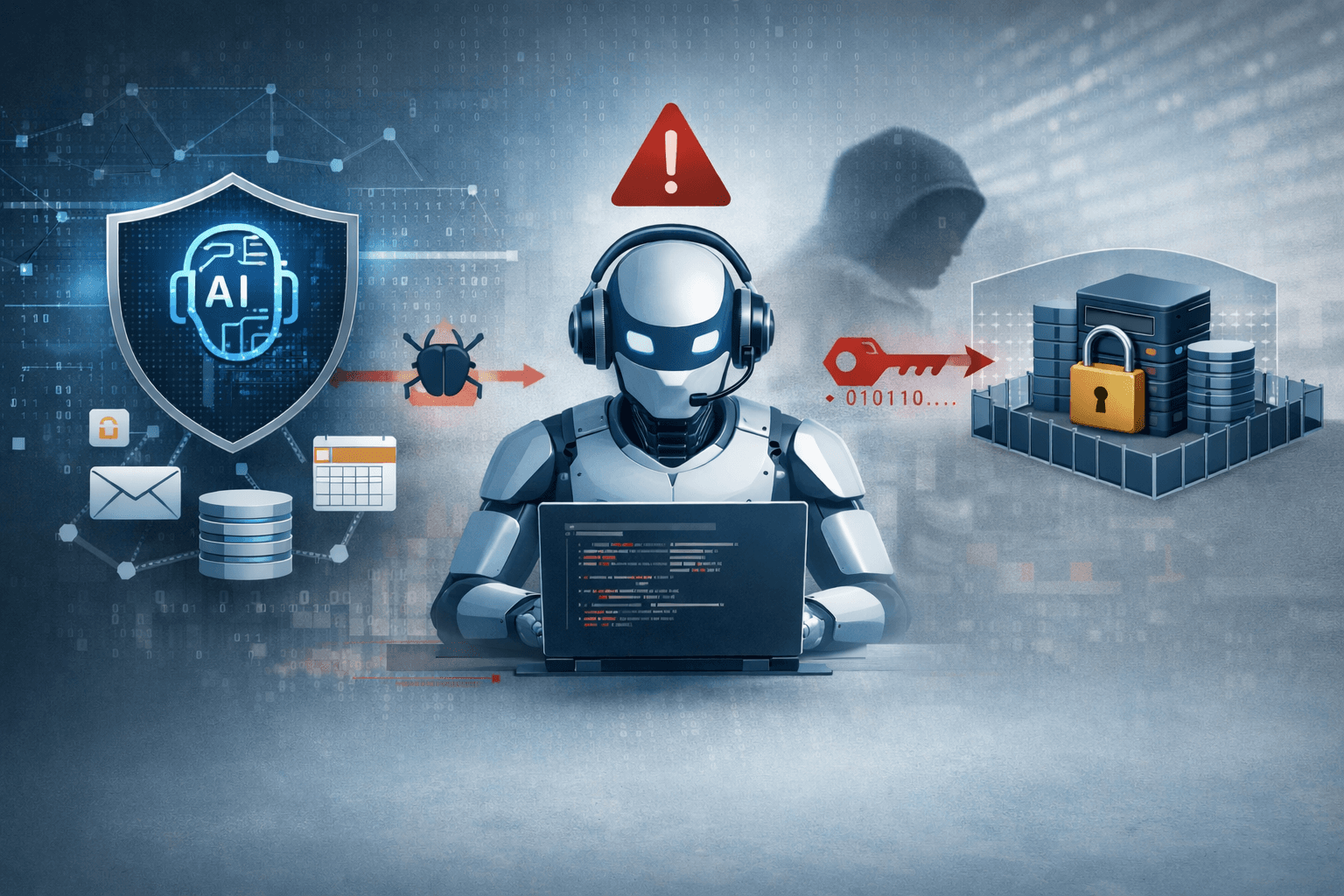
Autonomous AI agents are no longer experimental — and neither are the risks they carry. According to Microsoft's Security Blog, self-hosted AI agent runtimes execute untrusted code and process unverified inputs using your credentials, creating a threat surface that most enterprise security teams have not yet accounted for. In 2024 alone, prompt injection attacks targeting AI systems increased by over 300% (OWASP AI Security Project, 2024), and the attack surface is expanding as organizations rush to pilot agentic frameworks.
This guide walks security professionals through the specific threat scenarios Microsoft has documented for runtimes like OpenClaw, outlines a minimum safe posture for enterprise deployments, and provides actionable detection guidance using Microsoft Defender XDR. Whether you are evaluating your first agent deployment or hardening one already in production, understanding these risks now is far less costly than responding to a breach later.
Understanding the AI Agent Runtime Threat Landscape
Self-hosted agent runtimes differ fundamentally from traditional software deployments. They fetch skills dynamically, process external content at runtime, and act on behalf of authenticated users — often with broad permissions. This combination creates a uniquely dangerous attack surface.
Why Agent Runtimes Are a High-Value Target
Unlike a static web application, an AI agent runtime blends code execution, credential usage, and natural language processing into a single pipeline. Attackers who influence any stage of that pipeline can potentially achieve lateral movement, data exfiltration, or host compromise — without ever touching a firewall rule.
Key factors elevating risk include:
- Agents inherit the permissions of the running user or service account
- External inputs (web pages, documents, API responses) are processed as trusted content
- Skills and plugins may be sourced from community repositories with minimal vetting
- Memory stores persist context across sessions, creating exfiltration targets
The Credential Exfiltration Problem
When an agent runtime authenticates to downstream services — email, calendars, internal APIs — it typically does so with real user or service account credentials. If an attacker can influence the agent's actions through a malicious input, those credentials can be silently exfiltrated or abused mid-session.
Microsoft's documentation describes scenarios where an agent, acting on a poisoned instruction, sends authentication tokens to an attacker-controlled endpoint. The user sees normal activity. The agent has already been compromised.
Primary Attack Vectors Against Agent Runtimes
Understanding how attacks unfold is the first step toward building effective defenses. Microsoft identifies several high-priority scenarios that security teams should model before deployment.
Poisoned Skills from Community Repositories
Platforms like ClawHub allow developers to publish and share agent skills — reusable modules that extend agent capabilities. This creates a software supply chain risk analogous to malicious npm or PyPI packages, but with the added danger that skills can execute within a privileged agent context.
A poisoned skill might:
- Silently exfiltrate memory contents or session tokens
- Establish persistence by modifying the agent's configuration
- Pivot to internal network resources using inherited credentials
- Alter agent behavior for subsequent tasks without alerting the user
Pro Tip: Treat community-sourced skills the same way you treat third-party code libraries — require review, pin versions, and sandbox execution wherever possible.
Indirect Prompt Injection
Indirect prompt injection (IPI) occurs when malicious instructions are embedded in external content the agent retrieves and processes — a webpage, a PDF, an email body. The agent interprets attacker-controlled text as legitimate instructions and acts accordingly.
Table: Prompt Injection Attack Types Compared
| Attack Type | Vector | Attacker Control | Detection Difficulty |
|---|---|---|---|
| Direct Prompt Injection | User input field | High | Low-Medium |
| Indirect Prompt Injection | Retrieved external content | Medium-High | High |
| Skill Poisoning | Community repository | Medium | Medium |
| Memory Tampering | Persistent memory store | Medium | High |
Memory Tampering and Persistent Context Abuse
Many agent runtimes maintain a persistent memory store that carries context across conversations and tasks. Attackers who successfully inject into this store can influence future agent behavior long after the initial compromise — a sleeper persistence technique that standard endpoint detection may miss entirely.
Minimum Safe Posture for Enterprise Deployments
Microsoft outlines a baseline security posture that every organization should implement before running a self-hosted agent runtime in any environment connected to production data or services.
Isolation and Credential Hygiene
The most effective single control is isolation. Running agent runtimes inside dedicated virtual machines (VMs) or containers — separate from other workloads — limits the blast radius of a compromise dramatically.
Equally important is credential separation. Agents should never run with user credentials that have access to sensitive systems beyond their defined task scope.
- Provision dedicated service accounts with least-privilege access
- Rotate credentials on a defined schedule, independent of user account cycles
- Avoid storing long-lived tokens in agent memory stores
- Use short-lived, scoped tokens where the target service supports them
- Audit all credential usage through a centralized identity provider
Table: Minimum Safe Posture Controls
| Control Area | Requirement | Framework Reference |
|---|---|---|
| Network Isolation | Dedicated VM/container, no lateral access | CIS Control 12, NIST SP 800-53 |
| Credential Management | Dedicated accounts, least privilege | ISO 27001 A.9, CIS Control 5 |
| Input Validation | Sanitize all external content before processing | MITRE ATT&CK T1059 |
| Monitoring | Full audit logging of agent actions and API calls | SOC 2 CC7, NIST CSF DE.CM |
| Rebuild Capability | Documented, tested rebuild runbook | NIST SP 800-61 |
Monitoring, Logging, and Rebuild Planning
Deploying an agent runtime without comprehensive logging is equivalent to running a privileged process with no audit trail. Every action the agent takes — API calls, file writes, outbound connections — should generate log data that flows into your Security Information and Event Management (SIEM) platform.
Equally critical is maintaining a tested rebuild plan. If an agent runtime is compromised, your team should be able to destroy and rebuild the environment from a known-good state within a defined recovery time objective (RTO).
Important: A rebuild plan that has never been tested is not a rebuild plan. Schedule quarterly dry runs and document each step.
Detection with Microsoft Defender XDR
Microsoft provides hunting queries for Defender XDR (Extended Detection and Response) that help security teams both discover agent runtime deployments and detect anomalous behavior in existing deployments.
Identifying Runtime Deployments
Many organizations are running AI agent runtimes without formal security review — piloted by developers or business units operating outside standard change management processes. Defender XDR queries can surface these deployments by identifying process trees, network connections, and file system patterns characteristic of popular runtimes.
Recommended hunting focus areas include:
- Processes spawning from Python or Node.js interpreters with outbound HTTPS connections
- Service accounts making API calls to LLM (Large Language Model) endpoints outside approved lists
- Unusual write activity to configuration or memory store files
- Scheduled tasks or cron jobs associated with agent persistence
Behavioral Anomaly Detection
Once a deployment is identified, behavioral baselining becomes your most powerful tool. Agents operating normally exhibit consistent, predictable patterns. Deviations — unexpected outbound destinations, unusual data volumes, atypical API call sequences — are strong indicators of compromise or manipulation.
Table: Detection Signal Priority
| Signal | Risk Level | Recommended Response |
|---|---|---|
| Agent calling unapproved external endpoints | Critical | Isolate and investigate immediately |
| Credential use outside expected service scope | High | Revoke token, audit session history |
| New skill installation outside change window | High | Block and review skill provenance |
| Elevated data volume in memory store | Medium | Flag for analyst review |
| Repeated failed API authentication attempts | Medium | Correlate with identity provider logs |
Compliance Considerations for Agent Deployments
Organizations operating under regulatory frameworks face additional obligations when deploying AI agent runtimes that process or have access to regulated data.
Mapping Agent Risks to Compliance Frameworks
Under GDPR (General Data Protection Regulation), any agent that processes personal data must operate under a documented legal basis, with data minimization and purpose limitation controls in place. An agent with access to employee or customer data that exfiltrates that data — even as a result of an attack rather than deliberate design — creates direct regulatory exposure.
HIPAA (Health Insurance Portability and Accountability Act) requires that covered entities and business associates implement technical safeguards preventing unauthorized access to protected health information (PHI). Running an agent runtime with access to PHI without isolation controls almost certainly violates the HIPAA Security Rule.
PCI DSS (Payment Card Industry Data Security Standard) v4.0 explicitly addresses AI and automation risks in its updated requirements, requiring organizations to assess and document risks from automated tools that interact with cardholder data environments.
Key Takeaways
- Isolate every agent runtime in a dedicated VM or container before connecting it to any production system or credential
- Provision dedicated, least-privilege service accounts for agent use — never run agents with user-level credentials that exceed task scope
- Sanitize all external content before it enters the agent processing pipeline to reduce indirect prompt injection risk
- Vet community-sourced skills as rigorously as third-party code libraries, and pin versions in production deployments
- Implement comprehensive logging of all agent actions and route those logs to your SIEM for continuous monitoring
- Maintain and regularly test a documented rebuild runbook so your team can recover from agent compromise within your defined RTO
Conclusion
AI agent runtimes represent a meaningful productivity opportunity for enterprises — and a meaningful security challenge. The risks Microsoft has documented are not theoretical. Credential exfiltration, indirect prompt injection, and poisoned skill supply chains are active threat vectors that security teams need to model and defend against before pilots become production deployments.
The good news is that the minimum safe posture is achievable. Isolation, dedicated credentials, comprehensive logging, and a tested rebuild plan address the majority of documented attack scenarios. Pairing those controls with Defender XDR hunting queries gives your team the visibility to detect what your perimeter never will.
Start with your current agent deployments. Find them, assess them against the controls in this guide, and close the gaps before an attacker finds them first.
Frequently Asked Questions
Q: What makes AI agent runtimes more dangerous than traditional software deployments? A: Agent runtimes combine code execution, credential usage, and natural language processing in a single pipeline, and they process untrusted external content as part of normal operation. This means an attacker who can influence what the agent reads or retrieves can potentially direct privileged actions without ever compromising the host directly.
Q: What is indirect prompt injection and how does it differ from standard prompt injection? A: Standard prompt injection involves an attacker directly manipulating user-facing input fields to alter model behavior. Indirect prompt injection embeds malicious instructions in external content — webpages, documents, emails — that the agent fetches and processes, making it far harder to detect and filter at the point of entry.
Q: How should organizations vet skills sourced from community repositories like ClawHub? A: Treat community skills the same way your team treats open-source dependencies — review source code before use, check for recent maintainer activity and reported issues, pin to specific verified versions in production, and sandbox execution in an isolated environment before promoting to any system with access to sensitive data.
Q: Which compliance frameworks are most directly implicated by AI agent runtime deployments? A: GDPR, HIPAA, and PCI DSS v4.0 all have provisions that apply directly to automated systems processing regulated data. Organizations should conduct a formal risk assessment mapping agent capabilities and data access to their applicable compliance obligations before deployment.
Q: How do you detect an AI agent runtime that was deployed without a formal security review? A: Microsoft Defender XDR hunting queries can surface agent deployments by identifying process patterns, outbound connections to LLM endpoints, and file system activity characteristic of popular runtimes. Regular scanning of service account activity for calls to AI APIs outside an approved inventory is an effective low-effort detection method.

Enjoyed this article?
Subscribe for more cybersecurity insights.