
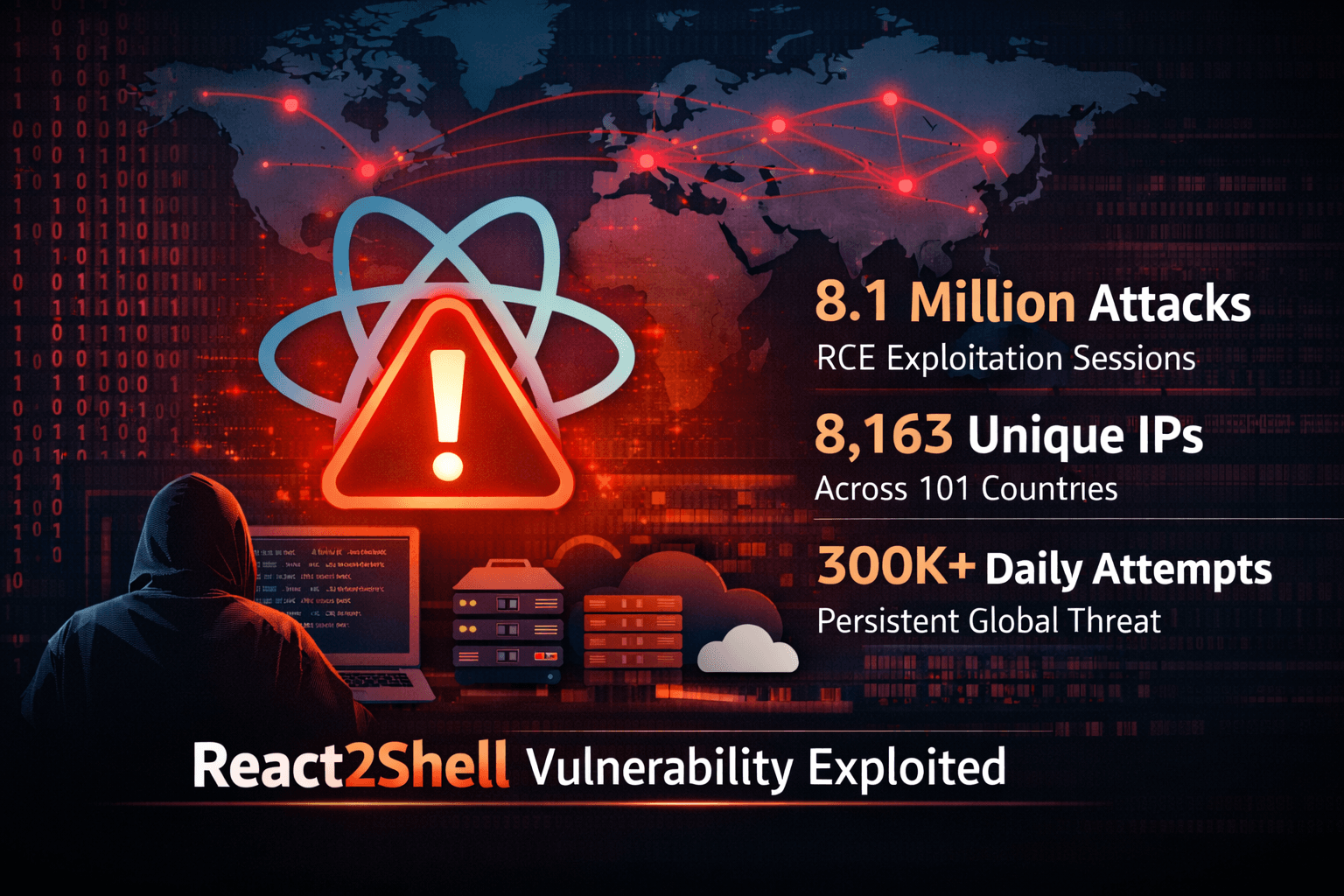
Since its disclosure, the so-called ‘React2Shell’ vulnerability (no public CVE assignment at the time of writing) has become one of 2025's most aggressively exploited security flaws. According to reported telemetry cited by security researchers, attackers have launched over 8.1 million exploitation sessions targeting exposed React Server Components, with daily attack volumes stabilizing around 300,000 to 400,000 attempts after peaking above 430,000 in late December.
What makes this campaign particularly concerning is its scale and diversity. Multiple security research reports indicate approximately 8,163 unique source IP addresses originating from 1,071 autonomous systems across 101 countries. This geographic and infrastructure spread confirms that React2Shell has attracted multiple threat actor groups, botnet operators, and opportunistic attackers who recognize the vulnerability's potential for rapid compromise.
The exploitation pattern reveals sophisticated tradecraft including two-stage payload delivery, AMSI bypass techniques, and constant infrastructure rotation that renders traditional IP-based blocking ineffective. Organizations running React Server Components face an active, sustained threat that demands immediate attention and a fundamental shift in defensive strategy.
Understanding the React2Shell Vulnerability Landscape
React2Shell represents a critical remote code execution vulnerability in React Server Components, a framework feature that enables server-side rendering and data handling. The flaw allows unauthenticated attackers to execute arbitrary code on vulnerable servers through specially crafted HTTP requests.
Attack Surface and Exposure
The vulnerability affects applications using React Server Components in production environments where server-side rendering processes untrusted input. Organizations that deployed React's server components to improve application performance and reduce client-side processing have inadvertently created entry points for exploitation.
Exposure is particularly high among:
- Web applications using Next.js with server components enabled
- Enterprise portals implementing React-based server-side rendering
- SaaS platforms leveraging React Server Components for multi-tenant architectures
- Development and staging environments running vulnerable versions
Scale of Active Exploitation
Reported telemetry from security research sources paints a stark picture of exploitation intensity. The 8.1 million recorded attack sessions represent sustained, opportunistic scanning rather than targeted campaigns. Daily attack volumes have normalized to 300,000-400,000 attempts, indicating that React2Shell has become part of standard botnet and vulnerability scanner playbooks.
The attack infrastructure reveals significant diversity, with reports indicating approximately 8,163 unique source IPs distributed across 1,071 autonomous system numbers (ASNs) in 101 countries. This distribution demonstrates that numerous independent threat actors are exploiting the vulnerability simultaneously, from sophisticated groups to automated scanning operations.
Table: Attack Volume Metrics
| Metric | Volume | Implication |
|---|---|---|
| Total attack sessions | 8.1 million+ | Sustained global campaign |
| Peak daily attempts | 430,000+ | High-intensity exploitation |
| Current daily average | 300,000-400,000 | Normalized threat level |
| Unique source IPs | 8,163 | Distributed attack infrastructure |
| Countries involved | 101 | Global geographic spread |
Attack Infrastructure and Tradecraft Analysis
The technical fingerprinting of React2Shell exploitation attempts reveals sophisticated infrastructure management and tool diversity that complicates traditional defensive approaches.
Cloud Provider Concentration
Analysis of attacking IP addresses shows heavy reliance on cloud and hosting infrastructure. Amazon Web Services accounts for more than one-third of all observed exploitation attempts, while the top 15 autonomous systems collectively represent approximately 60% of source IPs. This concentration reflects attackers' preference for elastic, disposable infrastructure that can be rapidly deployed and abandoned.
Cloud provider abuse enables several tactical advantages:
- Rapid provisioning of new attack nodes when previous infrastructure is blocked
- Geographic distribution without physical presence requirements
- Legitimate-appearing IP addresses that may bypass reputation-based filters
- Cost-effective scaling of exploitation campaigns
Infrastructure Churn and Rotation
A significant portion of attacking IP addresses were first observed after July 2025, demonstrating aggressive infrastructure turnover. This rotation strategy defeats static IP blocklists by ensuring that by the time an address is identified and blocked, attackers have already pivoted to fresh infrastructure.
The churn pattern indicates attackers are using short-lived virtual private servers (VPS) and cloud instances specifically allocated for exploitation campaigns. Organizations relying on manually curated IP blocklists find themselves perpetually behind the threat curve.
Tool and Payload Diversity
Fingerprinting analysis across multiple reports indicates tens of thousands of unique payload variations deployed against vulnerable React Server Components. Additionally, hundreds of distinct JA4H and JA4T fingerprints were detected, confirming that attackers employ diverse tools, frameworks, and automation platforms.
This diversity suggests:
- Multiple independent threat groups conducting parallel campaigns
- Automated vulnerability scanners integrating React2Shell checks
- Custom tooling developed specifically for this vulnerability
- Continuous payload evolution to evade signature-based detection
Table: Infrastructure Fingerprinting
| Category | Count | Security Implication |
|---|---|---|
| Unique payloads | Tens of thousands | High evasion capability |
| JA4H fingerprints | Hundreds | Diverse HTTP clients |
| JA4T fingerprints | Hundreds | Varied network stacks |
| New IPs (post-July 2025) | Significant portion | Rapid infrastructure rotation |
| ASNs represented | 1,071 | Distributed hosting sources |
Two-Stage Exploitation Methodology
React2Shell attacks follow a consistent two-stage pattern that balances reconnaissance efficiency with payload delivery effectiveness.
Stage One: Validation and Reconnaissance
In many observed campaigns, initial exploitation attempts use simple PowerShell arithmetic commands to validate that remote code execution is possible. These validation payloads are designed to:
- Confirm the vulnerability exists and is exploitable
- Verify that PowerShell execution is available on the target system
- Test whether command output can be retrieved
- Minimize detection risk through innocuous-appearing commands
The arithmetic command approach (such as executing basic calculations) produces predictable output that automated tools can verify, allowing attackers to quickly identify successfully compromised systems for follow-up exploitation.
Stage Two: Encoded Payload Delivery
Once validation succeeds, attackers deliver encoded PowerShell payloads designed to establish persistence, exfiltrate data, or deploy additional malware. These second-stage payloads frequently incorporate Anti-Malware Scan Interface (AMSI) bypass techniques to evade endpoint detection and response (EDR) tools.
AMSI bypass allows malicious PowerShell scripts to execute without triggering Windows Defender or third-party antivirus solutions that rely on AMSI for script scanning. Common bypass methods include:
- Reflection-based AMSI context manipulation
- Memory patching of AMSI validation functions
- Obfuscation techniques that evade AMSI signature detection
The encoded delivery further complicates detection by hiding malicious intent from network monitoring tools and security information and event management (SIEM) systems that perform static analysis of network traffic.
Attack Flow Timeline
Table: React2Shell Exploitation Stages
| Stage | Action | Purpose | Detection Indicator |
|---|---|---|---|
| 1 | Reconnaissance scan | Identify vulnerable endpoints | Repeated requests to React component paths |
| 2 | Validation exploit | Confirm RCE capability | PowerShell arithmetic commands |
| 3 | Encoded payload delivery | Deploy malicious code | Base64-encoded PowerShell |
| 4 | AMSI bypass execution | Evade endpoint protection | AMSI context manipulation |
| 5 | Post-exploitation | Persistence/exfiltration | Suspicious process creation |
Why Traditional Defenses Are Insufficient
The React2Shell campaign demonstrates why static, manually updated security controls cannot effectively counter modern, distributed exploitation efforts.
The IP Blocklist Problem
Static IP blocklists fail against React2Shell exploitation for three critical reasons. First, the sheer volume of attacking infrastructure—8,163 unique IPs and counting—exceeds the practical management capacity of manual blocklist curation. Second, the constant infrastructure rotation means that blocklists become outdated within hours or days of creation. Third, the concentration of attacks from legitimate cloud providers creates false positive risks when blocking entire IP ranges.
Organizations that rely exclusively on blocklists experience a defensive lag: by the time an IP address is identified, investigated, and added to block rules, attackers have already moved to new infrastructure. This reactive approach cannot match the pace of automated infrastructure provisioning available to modern threat actors.
Signature-Based Detection Limitations
The tens of thousands of unique payloads observed in React2Shell exploitation overwhelm signature-based detection systems. Each payload variation requires a new signature, creating an arms race that defenders cannot win. Attackers continuously modify payload encoding, obfuscation, and structure to evade static signatures while maintaining functional exploitation capability.
Furthermore, the use of PowerShell—a legitimate administrative tool present in virtually all Windows environments—complicates signature creation. Overly broad signatures risk blocking legitimate administrative activities, while narrow signatures are easily evaded through minor payload modifications.
Perimeter-Only Security Models
React2Shell exploitation succeeds against organizations that focus exclusively on perimeter defenses without adequate endpoint monitoring and response capabilities. The vulnerability exists in application logic, not at the network perimeter, allowing attacks to bypass firewalls and intrusion prevention systems (IPS) that cannot inspect encrypted HTTPS traffic or understand application-layer context.
Once exploitation succeeds and PowerShell executes, perimeter controls provide no visibility or blocking capability. Organizations need defense-in-depth approaches that include endpoint detection, PowerShell logging, and behavioral analysis.
Effective Defense Strategies for Active Threats
Protecting against React2Shell requires a multi-layered approach that addresses both immediate vulnerability remediation and ongoing threat detection.
Immediate Patching and Mitigation
The highest priority action is applying available patches for React Server Components. Organizations should:
- Identify all applications using React Server Components in production, staging, and development environments
- Prioritize patching based on external exposure and data sensitivity
- Implement temporary mitigations such as disabling server components or restricting access while patching is in progress
- Verify patch effectiveness through vulnerability scanning and penetration testing
For systems that cannot be immediately patched due to compatibility concerns or change management requirements, implement compensating controls including web application firewalls (WAF) with rules specifically designed to detect and block React2Shell exploitation patterns.
Dynamic Threat Intelligence Integration
Replace or supplement static IP blocklists with continuously updated threat intelligence feeds such as GreyNoise. Dynamic threat intelligence provides:
- Real-time identification of IPs actively scanning for or exploiting React2Shell
- Automatic blocking of newly identified malicious infrastructure
- Context about threat actor behavior and campaign characteristics
- Reduced false positives through reputation scoring and behavioral analysis
Integration with security orchestration, automation, and response (SOAR) platforms enables automatic blocking actions based on threat intelligence updates, eliminating the defensive lag inherent in manual blocklist management.
Endpoint Monitoring and Response
Implement comprehensive PowerShell logging and monitoring to detect exploitation attempts and successful compromises. Key monitoring focuses include:
- All PowerShell command executions, particularly encoded commands
- AMSI bypass indicators such as reflection usage and memory manipulation
- Unusual process creation chains involving PowerShell
- Network connections initiated by PowerShell processes
Configure Windows Event Logging to capture PowerShell script block logging (Event ID 4104) and module logging (Event ID 4103). Forward these logs to SIEM platforms with detection rules specifically targeting React2Shell exploitation patterns.
Table: Defense Layer Recommendations
| Defense Layer | Control Type | Implementation Priority | Expected Impact |
|---|---|---|---|
| Application | Patch React Server Components | Critical (Immediate) | Eliminates vulnerability |
| Network | Dynamic threat intelligence feeds | High (Week 1) | Blocks known malicious IPs |
| Network | WAF with React2Shell rules | High (Week 1) | Blocks exploitation attempts |
| Endpoint | PowerShell logging and monitoring | High (Week 1) | Detects successful exploitation |
| Endpoint | AMSI bypass detection | Medium (Month 1) | Identifies evasion techniques |
Behavioral Analysis and Anomaly Detection
Deploy behavioral analysis tools that establish baselines for normal PowerShell usage and alert on deviations. React2Shell exploitation creates several behavioral anomalies:
- PowerShell executions initiated by web server processes
- Encoded commands executed in contexts where encoding is unusual
- AMSI-related function calls from unexpected processes
- Outbound network connections to high-risk or newly registered domains
Machine learning-based endpoint detection and response (EDR) solutions can identify these anomalies even when specific exploit signatures are unknown, providing defense against payload variations and zero-day exploitation techniques.
Key Takeaways
- React2Shell has generated over 8.1 million reported exploitation sessions from approximately 8,163 unique IPs across 101 countries, confirming sustained global threat activity
- Static IP blocklists cannot counter the attack campaign due to massive infrastructure scale, constant rotation, and cloud provider concentration
- Attackers employ two-stage exploitation with PowerShell validation followed by AMSI-bypass payloads, requiring endpoint-focused detection
- Organizations must prioritize immediate patching, deploy dynamic threat intelligence feeds, and implement comprehensive PowerShell monitoring
- Defense-in-depth strategies combining application security, network controls, and endpoint detection are essential for protecting against modern distributed exploitation campaigns
- The tens of thousands of unique payloads and hundreds of tool fingerprints demonstrate that signature-based detection alone is insufficient against adaptive threat actors.
Conclusion
The React2Shell exploitation campaign represents a critical case study in how modern threat actors leverage automation, cloud infrastructure, and distributed operations to exploit vulnerabilities at scale. With daily attack volumes stabilizing around 300,000-400,000 attempts and no signs of declining threat actor interest, organizations running React Server Components face an active, persistent risk.
Traditional defensive approaches centered on static blocklists and signature-based detection have proven inadequate against the campaign's volume, diversity, and infrastructure churn. Effective protection requires immediate vulnerability remediation combined with dynamic threat intelligence, comprehensive endpoint monitoring, and behavioral analysis capabilities.
Security teams should treat React2Shell as an urgent patching priority, implement PowerShell logging and AMSI bypass detection, and transition from reactive IP blocking to proactive threat intelligence integration. The sustained exploitation activity confirms that attackers view React Server Components as valuable targets worthy of continued investment in tool development and infrastructure provisioning.
Frequently Asked Questions
Q: What makes React2Shell different from other remote code execution vulnerabilities? A: React2Shell's exploitation scale sets it apart, with reported telemetry indicating over 8.1 million attack sessions from 8,163 unique IPs across 101 countries. The vulnerability affects React Server Components, a widely deployed framework feature, creating a large attack surface. Additionally, the two-stage exploitation methodology with AMSI bypass techniques demonstrates sophisticated attacker tradecraft specifically tailored to evade modern endpoint protection.
Q: Why are IP blocklists ineffective against React2Shell exploitation campaigns?
A: The campaign's massive infrastructure scale (1,071 ASNs), constant rotation (50% of IPs first seen after July 2025), and heavy use of legitimate cloud providers overwhelm manual blocklist management. By the time an IP is identified and blocked, attackers have already provisioned new infrastructure. Dynamic threat intelligence feeds that update continuously are necessary to counter this infrastructure churn.
Q: How can organizations detect successful React2Shell exploitation on their systems?
A: Enable comprehensive PowerShell logging including script block logging (Windows Event ID 4104) and monitor for encoded PowerShell commands, AMSI bypass indicators, and unusual process chains involving web server processes spawning PowerShell. Deploy endpoint detection and response (EDR) solutions with behavioral analysis to identify anomalous PowerShell activity and suspicious network connections initiated by PowerShell processes.
Q: What immediate steps should organizations take if they run React Server Components?
A: First, inventory all systems using React Server Components across production, staging, and development environments. Second, apply available security patches immediately, prioritizing externally exposed systems. Third, implement compensating controls such as web application firewall rules and access restrictions for systems that cannot be patched immediately. Finally, enable PowerShell logging and integrate dynamic threat intelligence feeds to detect and block exploitation attempts.
Q: Will patching alone eliminate the React2Shell threat to my organization?
A: Patching eliminates the vulnerability but does not address systems that may have been compromised before patching. Organizations should conduct forensic analysis of PowerShell logs, process creation events, and network traffic from the period between vulnerability disclosure and patch deployment. Additionally, maintain ongoing threat monitoring because attackers may have established persistence mechanisms that survive patching, requiring detection and remediation through endpoint security tools.

Enjoyed this article?
Subscribe for more cybersecurity insights.