
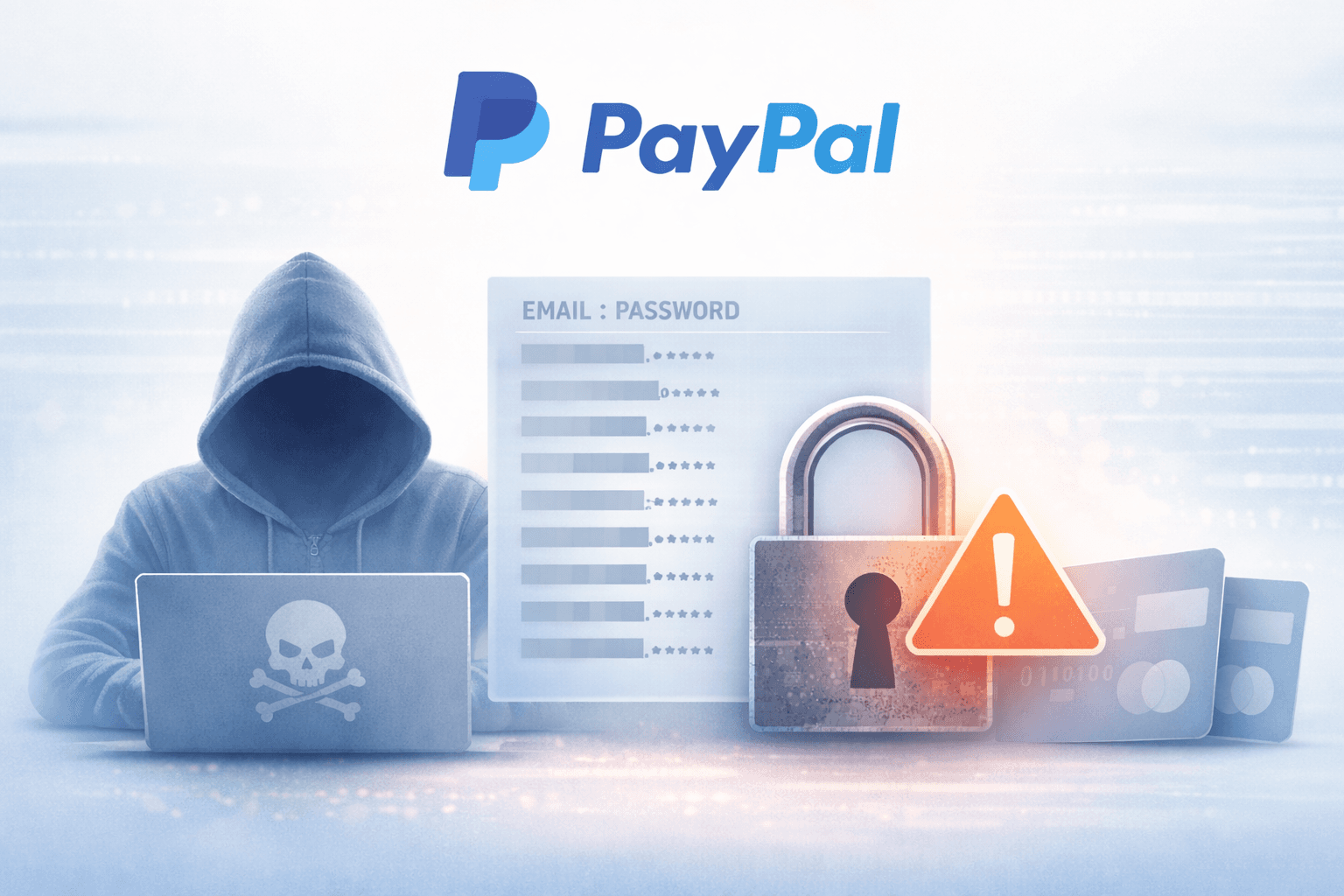
In early January 2026, cybersecurity researchers reported claims on underground forums that a threat actor operating under the handle "Lud" began circulating a dataset containing 104,472 email-password combinations allegedly linked to PayPal accounts. While the incident sparked immediate concern across financial security circles, early investigations reveal a critical distinction that every organization must understand.
PayPal has stated it has no evidence that its systems were breached in connection with these claims.Instead, the incident represents something potentially more dangerous: the systematic exploitation of credential reuse through combolist distribution and automated account takeover attempts. For security teams, the implications extend far beyond a single service, exposing fundamental vulnerabilities in how users manage authentication across their digital ecosystem.
This analysis examines the January 2026 PayPal credential incident, explains how combolists fuel credential stuffing attacks, and provides actionable strategies to protect your organization from similar threats. Understanding these mechanics is essential as credential-based attacks continue escalating across the financial services sector.
Understanding Combolists and Credential Aggregation
Combolists represent one of the most efficient tools in a threat actor's arsenal, yet many organizations misunderstand their origin and purpose. These carefully curated databases combine credentials from multiple historical breaches, infostealer malware campaigns, and phishing operations into a single, searchable resource.
What Makes Combolists Valuable to Attackers
The January 2026 dataset exemplifies how attackers maximize value from aggregated credentials. Rather than targeting PayPal's infrastructure directly, threat actors compile previously compromised credentials and test them against high-value services where users are statistically likely to reuse passwords.
According to recent credential analysis studies, approximately 65% of users reuse passwords across multiple accounts (Security Research, 2024). This behavior transforms old breach data into fresh attack vectors. A credential compromised in a 2023 retail breach becomes a potential PayPal account takeover in 2026 if the user never changed that password.
The Mechanics of Credential Collection
Threat actors acquire credentials through three primary channels:
- Historical breach databases containing billions of exposed credentials from past incidents
- Infostealer malware deployed on victim devices to harvest browser-stored passwords and session cookies
- Phishing campaigns designed to capture credentials directly from unsuspecting users
Current reporting suggests the dataset may originate from infostealer malware logs or recycled breach data rather than from a confirmed PayPal system compromise. These malware variants systematically extract saved passwords from browsers, specifically targeting financial services credentials that command premium prices in underground markets.
Combolist Distribution and Monetization
Once assembled, combolists enter underground marketplaces where pricing depends on several factors. Fresh credentials from recent campaigns command higher prices, while verified working credentials from high-value services like PayPal can sell for premium rates.
Table: Combolist Pricing Factors
| Factor | Impact on Value | Example |
|---|---|---|
| Recency | High | 2026 data vs. 2023 data |
| Verification Status | Very High | Tested vs. untested credentials |
| Service Type | High | Financial vs. general accounts |
| Volume | Medium | 100K vs. 15M records |
Credential Stuffing: The Primary Attack Vector
Credential stuffing transforms static combolists into active threats through automation and scale. Understanding this attack methodology is essential for building effective defenses.
How Automated Testing Works
Attackers deploy specialized tools that systematically test credential pairs against target services. These tools can process thousands of login attempts per minute, rotating through proxy networks to avoid detection and rate limiting.
The process operates with minimal human intervention. Automated systems test each email-password combination, flag successful logins, and often attempt immediate fraudulent transactions or data exfiltration before security teams can respond.
Why PayPal Remains a Prime Target
Financial services platforms face disproportionate credential stuffing pressure due to immediate monetization opportunities. A successfully compromised PayPal account offers attackers multiple exploitation paths:
- Direct fund transfers to controlled accounts
- Fraudulent purchases using linked payment methods
- Access to connected bank account information
- Sale of verified accounts to other criminals
The claimed ~104,000 credentials in the January incident represent relatively modest scale compared to larger operations. In August 2025, forum users claimed that a threat actor known as ‘Chucky_BF’ was offering 15.8 million PayPal-linked credentials, though PayPal denied evidence of a system breach and independent verification was limited, demonstrating how credential aggregation operates at industrial scale.
Attack Success Rates and Impact
Even with a modest success rate, credential stuffing campaigns generate significant returns. Industry data suggests that 0.1% to 2% of credentials in typical combolists remain valid and unprotected by multi-factor authentication (Cybersecurity Analysis, 2025).
For the January 2026 dataset, this translates to potentially 100 to 2,000 vulnerable accounts. When each compromised account could yield hundreds or thousands in fraudulent transactions, the economic incentive becomes clear.
Important: Credential stuffing attacks succeed not because of sophisticated hacking techniques, but because they exploit the weakest link in security: human password behavior.
The Infostealer Malware Connection
Infostealer malware has emerged as the dominant source for fresh credential datasets, fundamentally changing how attackers acquire authentication data. This shift has profound implications for defensive strategies.
How Infostealers Harvest Credentials
Modern infostealer variants like Redline, Vidar, and Raccoon operate with alarming efficiency. Once installed on a victim's device through malicious downloads, software cracks, or phishing attachments, these tools systematically extract:
- Browser-stored passwords and autofill data
- Active session cookies and tokens
- Cryptocurrency wallet credentials
- FTP and email client passwords
- Saved payment information
The malware packages this data into organized logs, often categorized by service type. PayPal credentials receive special tagging due to their high market value, explaining why threat actors can assemble service-specific combolists like the January 2026 dataset.
The Scale of Infostealer Operations
Infostealer campaigns operate at staggering scale. Security researchers estimate that millions of devices worldwide harbor active infostealer infections, continuously feeding credential databases that fuel combolist creation.
A single malware campaign can compromise tens of thousands of devices within days. These credentials enter underground markets within hours, creating a constant stream of fresh data for credential stuffing operations.
Detection Challenges for Users
Infostealer infections often remain invisible to victims. Unlike ransomware or disruptive malware, infostealers execute quickly and quietly, harvesting data before removing themselves or remaining dormant. Users may never realize their credentials have been compromised until fraudulent activity appears on their accounts.
Table: Infostealer vs. Traditional Malware
| Characteristic | Infostealer | Traditional Malware |
|---|---|---|
| Visibility | Low (silent operation) | Often visible (system disruption) |
| Infection Duration | Minutes to hours | Days to months |
| Primary Goal | Data exfiltration | System control or destruction |
| User Awareness | Typically unaware | Often aware through symptoms |
Threat Intelligence and Early Warning Systems
The January 2026 incident demonstrates both the value and limitations of threat intelligence monitoring. Organizations must understand how to interpret and respond to early-stage alerts.
The Role of Dark Web Monitoring
Security firms like Hackmanac monitor underground forums and marketplaces where threat actors trade stolen data. This surveillance provides early warning when credential dumps surface, often before mainstream news coverage or official breach notifications.
However, these alerts arrive with important caveats. When researchers flag data as "pending verification," they signal that the dataset exists and is being traded, not that its contents are confirmed accurate or represent a new breach.
Interpreting Unverified Alerts
Organizations receiving threat intelligence alerts about credential dumps face a critical question: how do we respond to unverified claims? The answer requires balancing caution with proportional action.
For the PayPal incident, the "pending verification" status meant several possibilities existed:
- The credentials originated from previous breaches, not new PayPal compromise
- Some credentials might be valid while others are outdated or fabricated
- The dataset could be repackaged old data marketed deceptively as fresh
Understanding these nuances prevents both overreaction and dangerous complacency. The credentials pose real risk regardless of their source, but the response strategy differs from addressing an active system breach.
Proactive Response Strategies
Even unverified credential alerts justify specific defensive actions:
- Monitor authentication logs for unusual login patterns from affected email domains
- Prepare communication templates for potentially affected users
- Review multi-factor authentication adoption rates among user populations
- Analyze whether forced password reset campaigns are warranted
These measures acknowledge risk without assuming worst-case scenarios. They position organizations to respond quickly if verification confirms valid credential exposure.
Building Resilient Authentication Defense
The January 2026 incident and the August 2025 15.8 million credential dump underscore a fundamental truth: credential-based attacks will intensify as long as password reuse remains prevalent. Organizations must implement layered defenses that assume credential compromise will occur.
Multi-Factor Authentication as Critical Defense
Multi-factor authentication (MFA) remains the single most effective control against credential stuffing attacks. When properly implemented, MFA renders stolen passwords nearly useless without the second authentication factor.
Organizations should prioritize MFA adoption with these implementation strategies:
- Deploy app-based or hardware token MFA rather than SMS where possible
- Make MFA mandatory for accounts with financial access or sensitive data
- Educate users on MFA prompt fatigue attacks where attackers spam approval requests
- Monitor MFA adoption metrics and target low-adoption user segments
Pro Tip: Studies show that even basic MFA reduces account compromise risk by over 99% compared to password-only authentication (Security Standards, 2024).
Password Manager Deployment
Password managers address the root cause of credential reuse by enabling unique passwords for every service without user memorization burden. Enterprise deployment requires both technical provisioning and cultural change.
Effective password manager programs include:
- Selecting enterprise-grade solutions with security audits and compliance certifications
- Integrating password managers with single sign-on systems where appropriate
- Training users on secure password generation and vault management
- Establishing policies for shared credential management in team environments
Advanced Threat Detection
Organizations with mature security programs should implement behavioral analytics that detect credential stuffing attempts in real-time. These systems analyze authentication patterns for anomalies indicating automated attack traffic:
- Unusual geographic login locations inconsistent with user history
- Rapid succession login attempts across multiple accounts
- Failed login patterns matching known credential stuffing tools
- Login attempts using previously compromised credentials from threat intelligence feeds
Table: Defense Layer Effectiveness
| Defense Layer | Effectiveness Against Credential Stuffing | Implementation Complexity |
|---|---|---|
| Multi-Factor Authentication | Very High (99%+ reduction) | Medium |
| Password Managers | High (prevents reuse) | Medium |
| Behavioral Analytics | Medium-High (detection) | High |
| Rate Limiting | Medium (slows attacks) | Low |
| Device Fingerprinting | Medium (identifies automation) | Medium-High |
User Education and Security Culture
Technical controls require complementary user awareness programs. Even the best security infrastructure fails if users bypass protections through risky behavior.
Effective security awareness addresses specific threats users face:
- How to recognize phishing attempts that could install infostealer malware
- Why password reuse creates cascading risk across all accounts
- How to verify legitimate security alerts versus social engineering attempts
- The importance of keeping software updated to prevent malware infection
Organizations should deliver this education through multiple channels including onboarding programs, periodic training refreshers, simulated phishing exercises, and just-in-time warnings during risky actions.
Key Takeaways
- The January 2026 PayPal credential incident involved claims of approximately 104,000 email-password pairs, with current reporting suggesting the data may originate from infostealer malware or recycled breach data rather than a direct PayPal breach
- Combolists aggregate credentials from multiple sources and enable credential stuffing attacks against high-value services where users reuse passwords
- Infostealer malware represents the dominant source for fresh credential dumps, operating silently on millions of devices worldwide
- Threat intelligence provides early warning of credential exposure but requires careful interpretation of verification status
- Multi-factor authentication remains the most effective defense, reducing account compromise risk by over 99%
- Organizations must implement layered defenses including password managers, behavioral analytics, and user education to combat credential-based attacks
Conclusion
The January 2026 PayPal credential incident illuminates the evolving landscape of credential-based attacks. While this specific dataset has not been confirmed as a breach of PayPal’s systems, it demonstrates how attackers continuously exploit password reuse through combolist distribution and automated credential stuffing.
For security professionals, the incident reinforces several critical principles. First, credential compromise should be assumed rather than prevented, driving investment in controls that function even when passwords are exposed. Second, early threat intelligence alerts provide valuable warning despite verification uncertainty, enabling proactive defensive positioning. Finally, user behavior remains the ultimate vulnerability, making security awareness programs as critical as technical controls.
Organizations must move beyond reactive breach response toward comprehensive authentication resilience. This means mandatory multi-factor authentication, aggressive password manager adoption, behavioral analytics for attack detection, and continuous user education. The credential threat will intensify as infostealer malware proliferates and underground markets grow more sophisticated. Only layered, assumption-of-compromise defenses will prove adequate for this threat landscape.
Frequently Asked Questions
Q: How can I tell if my PayPal credentials were included in the January 2026 combolist?
A: PayPal has not confirmed that its systems were breached, so direct notification is unlikely. Use haveibeenpwned.com to check if your email appears in known breach databases. More importantly, if you reuse your PayPal password on other services, assume it may be compromised and change it immediately while enabling multi-factor authentication.
Q: What should organizations do when receiving "pending verification" threat intelligence alerts about credential dumps?
A: Treat unverified alerts as risk signals requiring measured response. Monitor authentication logs for unusual activity, review your MFA adoption rates, and prepare user communication templates. Avoid panic-driven forced password resets until verification is clearer, but don't ignore the alert entirely—the credentials likely pose some risk regardless of their exact source.
Q: Why do credential stuffing attacks succeed if passwords are several years old?
A: Most users never change passwords unless forced to by a security incident or policy requirement. A password compromised in a 2022 retail breach often remains valid in 2026 if the user hasn't changed it. Attackers exploit this inertia by continuously testing old credentials against new targets, knowing that password reuse creates persistent vulnerabilities.
Q: How do infostealer malware infections typically occur?
A: Common infection vectors include downloading cracked software or pirated content, opening malicious email attachments, clicking links in phishing messages, and installing browser extensions from untrusted sources. Infostealers often disguise themselves as legitimate utilities or hide inside bundled software downloads. Keeping antivirus software updated and avoiding downloads from unknown sources significantly reduces infection risk.
Q: Is SMS-based multi-factor authentication adequate protection against credential stuffing?
A: SMS-based MFA provides significantly better protection than password-only authentication, reducing compromise risk by over 90%. However, app-based authenticators or hardware security keys offer stronger protection against SIM-swapping attacks and phishing-resistant authentication. For high-value accounts, prioritize app-based or hardware MFA solutions over SMS where possible.

Enjoyed this article?
Subscribe for more cybersecurity insights.