
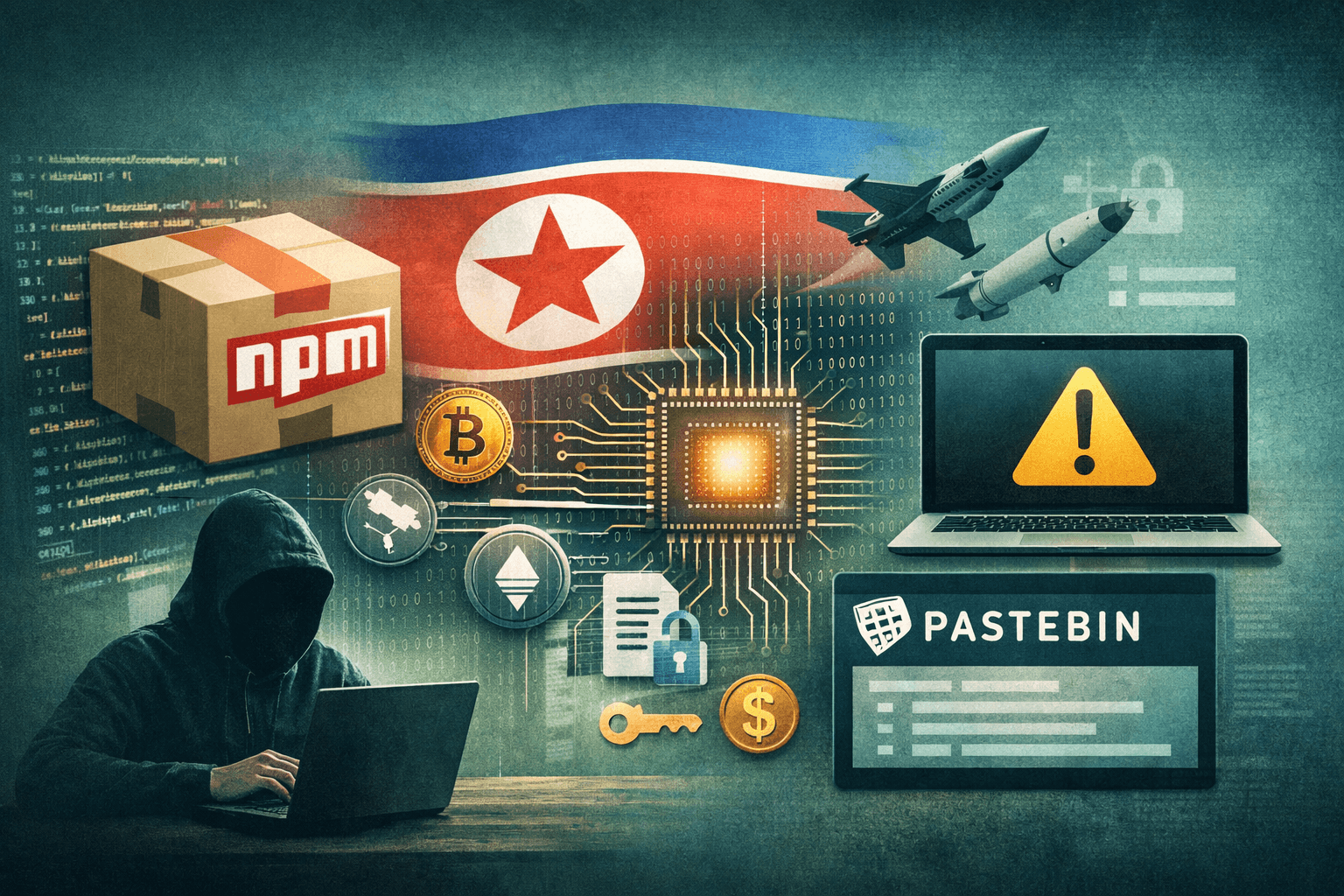
In early 2025, security researchers uncovered one of the most sophisticated npm supply chain attacks attributed to a nation-state actor. Twenty-six malicious packages, linked to North Korean Lazarus Group affiliates, quietly infiltrated the npm registry — the world's largest software package ecosystem with over 2.5 million packages and billions of weekly downloads. Developers across fintech, defense, and cryptocurrency sectors unknowingly installed tainted dependencies, exposing their systems to remote access trojans (RATs) capable of stealing data, executing arbitrary code, and establishing persistent footholds.
This attack is not an isolated incident. It represents a calculated evolution in nation-state tradecraft — blending into the open-source supply chain to reach high-value targets at scale. Understanding how this campaign operated, why it succeeded, and what your team must do differently is no longer optional. This article breaks down the attack mechanics, the threat actors behind it, and the concrete steps you can take to harden your development environment today.
How the Attack Worked: Malicious npm Packages and Pastebin C2
The campaign's technical sophistication sets it apart from typical malware waves. Attackers didn't just write malicious code — they architected a layered evasion system designed to defeat conventional defenses.
Masquerading as Legitimate Packages
Each of the 26 packages was crafted to appear trustworthy. Attackers leveraged typosquatting (registering names nearly identical to popular libraries), dependency confusion (exploiting how package managers resolve internal versus public packages), and in some cases, compromised developer credentials to publish from legitimate accounts.
The packages targeted common developer workflows — utilities for cryptographic operations, build tooling helpers, and API client wrappers. A developer rushing to meet a deadline would have no obvious reason to question the installation.
Pastebin-Based Command-and-Control Infrastructure
Once installed, the malicious packages reached out to Pastebin to retrieve command-and-control (C2) instructions. This technique is deliberately clever. Pastebin is a legitimate, widely-used service, which means outbound traffic to its domains rarely triggers firewall alerts. The C2 URLs updated dynamically, allowing attackers to rotate instructions and evade blocklists without redeploying the malware.
- RAT payloads were fetched and executed at runtime
- C2 channels supported cross-platform deployment across Windows, macOS, and Linux
- Dynamic URL rotation made static blocklists ineffective
- Pastebin's anonymity model prevented rapid attribution
Cross-Platform RAT Deployment
The embedded RATs delivered a full suite of malicious capabilities regardless of the victim's operating system. Attackers prioritized flexibility — a single package installation could compromise any developer's machine.
Table: RAT Capabilities by Impact Category
| Capability | Description | Risk Level |
|---|---|---|
| Remote Code Execution | Arbitrary commands run with user privileges | Critical |
| Data Exfiltration | Credentials, source code, API keys stolen | Critical |
| Persistence | Startup entries, cron jobs, scheduled tasks | High |
| Lateral Movement | Pivot from developer endpoint to production | High |
| Crypto Wallet Theft | Private key harvesting from local storage | Critical |
The Threat Actor: Lazarus Group's Supply Chain Playbook
Attribution of this campaign points to affiliates of Lazarus Group, North Korea's primary state-sponsored cyber unit operating under the Reconnaissance General Bureau (RGB). Lazarus has previously been linked to the $625 million Ronin Network breach, the 2014 Sony Pictures attack, and the WannaCry ransomware campaign.
Why npm? Strategic Targeting Through the Developer Trust Model
Nation-state actors choose supply chain attacks because of their asymmetric leverage. Compromising one widely-used package yields access to thousands of downstream organizations — without needing to breach each target individually. This mirrors the logic behind the 2020 SolarWinds attack, which compromised an IT monitoring platform to reach 18,000 organizations, including multiple U.S. federal agencies.
npm's trust model creates inherent vulnerability. Any registered account can publish packages. Package names can be reserved and squatted. Download counts and star ratings — proxies developers use to assess trustworthiness — can be gamed. The ecosystem was designed for speed and collaboration, not adversarial environments.
Target Sectors and Strategic Objectives
The campaign focused on three high-value sectors aligned with North Korea's strategic and financial priorities.
Table: Target Sectors and Attacker Objectives
| Sector | Primary Target Assets | North Korean Objective |
|---|---|---|
| Cryptocurrency | Wallets, private keys, exchange credentials | Sanctions evasion, revenue generation |
| Financial Technology | Payment APIs, customer PII, banking credentials | Intelligence, financial theft |
| Defense & Aerospace | Source code, internal tooling, R&D data | Espionage, IP theft |
Important: Organizations in these sectors should treat any unreviewed npm dependency as a potential vector and conduct immediate audits of recent package installations.
Detection: How Security Firms Uncovered the Campaign
The attack was detected through a combination of static analysis and behavioral monitoring — a reminder that no single detection method is sufficient.
Static Analysis Indicators
Researchers identified the malicious packages by analyzing published code for anomalous patterns:
- Obfuscated JavaScript with encoded strings resolving to Pastebin URLs
installlifecycle scripts executing network requests at package installation time- Suspicious
preinstallandpostinstallhooks not present in legitimate versions of mimicked packages - Hardcoded Pastebin domain references in package source code
Tools like Socket.dev, Snyk, and manual MITRE ATT&CK (Adversarial Tactics, Techniques, and Common Knowledge) framework analysis were used to map behaviors to known threat patterns.
Behavioral and Network Indicators
Runtime detection proved equally critical. Security operations teams hunting this campaign should look for:
- Outbound connections to
pastebin.comfrom CI/CD pipeline environments or developer workstations - Node.js processes spawning unexpected child processes immediately after
npm install - New persistence mechanisms (scheduled tasks, cron entries) created during or shortly after development environment setup
- Anomalous file read operations targeting
.ssh/,.aws/credentials, or cryptocurrency wallet directories
Pro Tip: Configure your SIEM (Security Information and Event Management) to alert on
pastebin.comDNS lookups originating from build servers or developer endpoints. Legitimate development workflows rarely require direct Pastebin access.
Mitigation: Hardening Your npm Security Posture
Defending against supply chain attacks requires layered controls across your development workflow, registry access, and runtime environment. A reactive posture is insufficient — you need proactive governance baked into your CI/CD pipeline.
Immediate Actions for Development Teams
Start with the controls that address the highest-risk vectors from this specific campaign.
- Run
npm auditon all active projects — identify packages with known vulnerabilities and flag recently added dependencies for manual review - Pin dependency versions — use exact version pinning (
"lodash": "4.17.21"not"^4.17.21") to prevent automatic upgrades to compromised versions - Enable npm package lock files — commit
package-lock.jsonoryarn.lockto source control and enforce integrity checks - Enable MFA on all npm accounts — stolen credentials enabled attackers to publish from legitimate accounts; mandatory multi-factor authentication (MFA) closes this vector
- Implement SBOM generation — create a Software Bill of Materials for every build to maintain visibility into your full dependency tree
Governance and Pipeline Controls
Table: DevSecOps Controls for Supply Chain Defense
| Control | Implementation | Compliance Alignment |
|---|---|---|
| Dependency scanning in CI/CD | Block builds with unvetted new packages | NIST SP 800-218, CIS Controls v8 |
| Private registry mirroring | Serve approved packages from internal mirror | SOC 2, ISO 27001 |
| Runtime behavior monitoring | Alert on anomalous process/network activity | MITRE ATT&CK, NIST CSF |
| SBOM generation per build | Track all transitive dependencies | Executive Order 14028 |
| MFA on registry accounts | Require hardware keys for publishing rights | PCI DSS 4.0, HIPAA |
Network-Level Mitigations
Block or monitor outbound connections to Pastebin and similar paste services from build environments. While these services have legitimate uses, their access from automated CI/CD systems or servers represents an anomaly worth investigating. Consider a zero-trust network architecture that requires explicit allowlisting of outbound destinations from build pipelines.
Key Takeaways
- Audit your npm dependencies immediately — run
npm auditand review any packages added in the past 90 days - Enable MFA on all registry accounts — credential compromise gave attackers a publishing foothold that MFA would have blocked
- Monitor for Pastebin traffic from build servers — outbound DNS or HTTP requests to
pastebin.comfrom CI/CD environments are a high-confidence indicator of compromise - Implement SBOM practices — you cannot defend what you cannot see; inventory every dependency in every build
- Pin dependency versions and enforce lock files — prevent automatic adoption of malicious package updates
- Integrate security scanning into CI/CD pipelines — catching malicious packages before deployment is exponentially cheaper than incident response after production compromise
Conclusion
The discovery of 26 North Korean-linked malicious npm packages is a defining moment for open-source security. Nation-state actors have recognized that the path of least resistance into high-value organizations often runs through the developer's terminal — not the firewall. By exploiting the trust developers place in open-source ecosystems, Lazarus Group affiliates achieved a reach that conventional intrusion methods could never match.
The stakes are not abstract. A single compromised dependency reaching a production fintech or defense environment can cascade into credential theft, lateral movement, and data exfiltration that takes months to detect and remediate. The controls exist — dependency pinning, SBOM generation, CI/CD scanning, registry MFA, and behavioral monitoring. The organizations that implement them systematically will weather the next supply chain campaign. Those that do not will become its case studies.
Start with your npm audit today. The next wave of malicious packages is already being published.
Frequently Asked Questions
Q: How can I tell if my project has already installed one of the 26 malicious npm packages?
A: Run npm audit in your project directory and cross-reference your package-lock.json against published indicators of compromise (IOCs) from threat intelligence sources covering this Lazarus Group campaign. Additionally, review your system for unexpected persistence mechanisms — new cron jobs, scheduled tasks, or startup entries created around the time of recent npm install operations.
Q: Why is Pastebin used as a C2 channel, and why is it hard to block?
A: Pastebin is a legitimate, widely trusted service, so outbound traffic to its domains rarely triggers default firewall rules or proxy filters. Attackers use it because URLs can be updated dynamically without redeploying malware, and Pastebin's anonymity model complicates rapid takedown. The most effective countermeasure is monitoring — alerting on Pastebin connections originating from build servers and developer endpoints rather than attempting a blanket block.
Q: Does enabling MFA on npm accounts actually prevent this type of attack?
A: MFA directly closes the vector used in part of this campaign — attackers leveraged previously stolen npm credentials to publish packages from accounts with existing reputation. MFA on publishing accounts would have prevented unauthorized package publication even with valid stolen passwords. npm now enforces MFA for maintainers of high-impact packages, but all organizations should mandate it for any account with publishing rights.
Q: What compliance frameworks require supply chain security controls relevant to this threat?
A: Several frameworks directly address software supply chain risk. NIST SP 800-218 (Secure Software Development Framework) and U.S. Executive Order 14028 mandate SBOM practices for federal contractors. CIS Controls v8 includes application software security controls. SOC 2 Type II audits increasingly assess software supply chain governance. Organizations subject to GDPR, HIPAA, or PCI DSS 4.0 face indirect exposure if compromised dependencies lead to data breaches triggering regulatory obligations.
Q: How does this attack differ from previous npm malware campaigns?
A: Earlier npm malware campaigns typically relied on opportunistic typosquatting with simple payload delivery. This campaign represents a significant evolution: nation-state resources, cross-platform RAT payloads, dynamic Pastebin-based C2 infrastructure to evade static blocklists, and in some cases use of legitimately compromised publishing credentials to bypass reputation-based trust signals. The combination of operational security sophistication and strategic target selection — crypto, fintech, and defense — distinguishes this as an advanced persistent threat (APT)-tier supply chain operation rather than commodity malware.

Enjoyed this article?
Subscribe for more cybersecurity insights.