
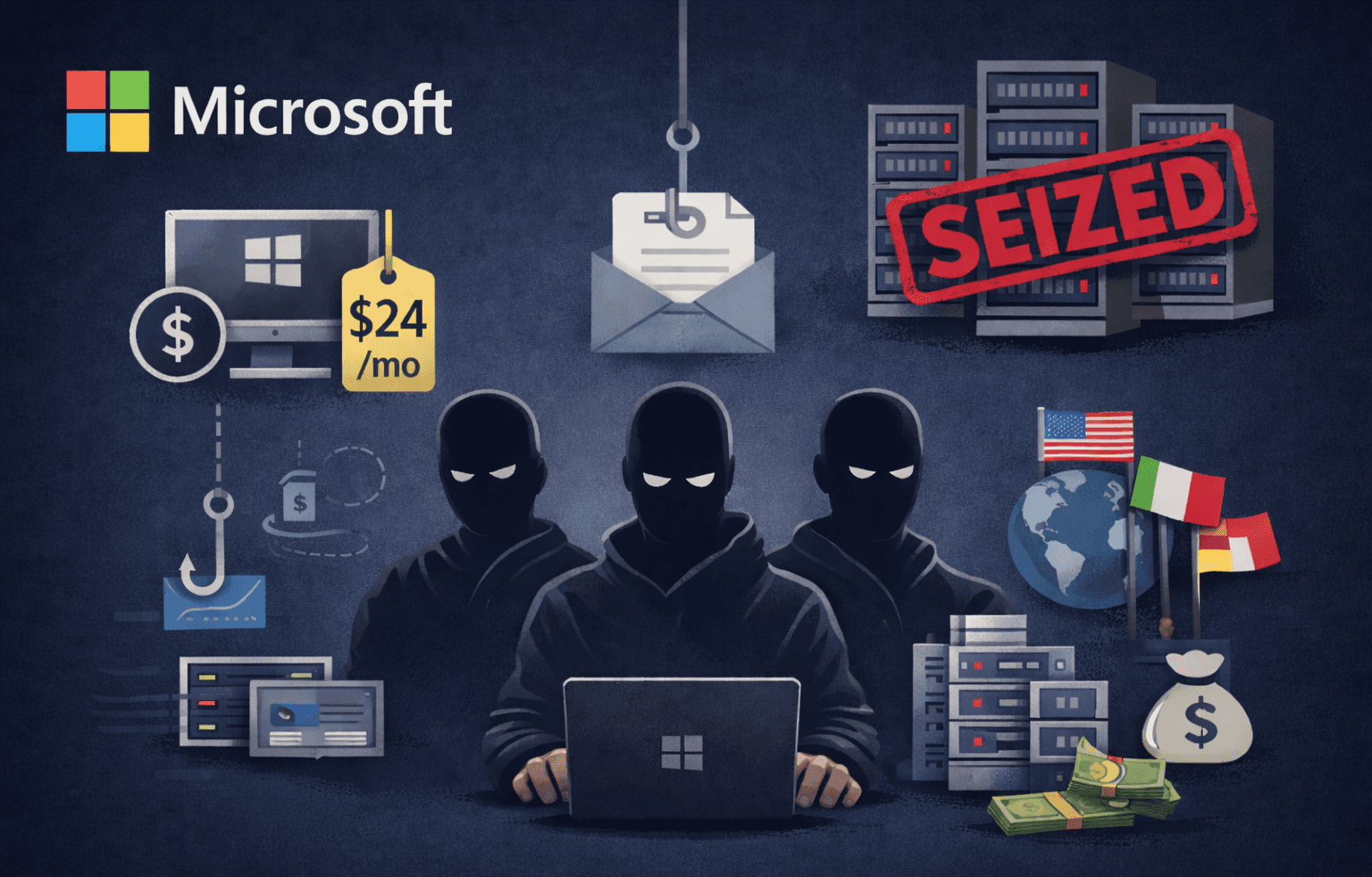
In March 2025, a mid-sized pharmaceutical company lost $7.3 million in a single business email compromise attack. The criminals behind it weren't elite hackers operating from a hidden bunker—they were customers of RedVDS, a virtual desktop service that anyone could rent for $24 per month. This case exemplifies a dangerous evolution in cybercrime: the democratization of sophisticated attack infrastructure through "cybercrime-as-a-service" platforms.
Microsoft's coordinated legal and technical operation has now disrupted RedVDS, seizing servers across multiple countries and effectively shuttering a marketplace that enabled thousands of criminals to launch phishing campaigns, execute BEC attacks, and deploy AI-enhanced fraud schemes. The platform’s reach was staggering—activity linked to RedVDS resulted in fraudulent access attempts or account compromise affecting more than 191,000 organizations worldwide, with at least $40 million in documented U.S. fraud losses since September 2025. This takedown reveals critical lessons about modern threat infrastructure and the escalating convergence of cloud services, artificial intelligence, and organized cybercrime.
The RedVDS Business Model: Cybercrime Infrastructure for Rent
What Made RedVDS Different
RedVDS operated since 2019 as a legitimate-appearing virtual desktop service (VDS) provider, publicly marketing itself as a standard hosting platform while quietly attracting criminal customers, offering Windows Server environments with full administrative privileges.Unlike traditional VPS providers, RedVDS failed to enforce meaningful abuse controls, a gap that made it particularly attractive to threat actors conducting phishing, BEC, and fraud operations by providing disposable cloud machines optimized for malicious activities. Customers could spin up fully-configured Windows servers in minutes, conduct their operations, and abandon the infrastructure without trace.
The service charged as little as $24 monthly per virtual machine, removing the technical barriers and capital requirements that once limited cybercrime to sophisticated operators. This pricing democratized access to enterprise-grade attack infrastructure, enabling even low-skill criminals to launch campaigns previously requiring significant resources.
Infrastructure Distribution Strategy
RedVDS maintained upstream servers across six countries: the United States, United Kingdom, France, Canada, the Netherlands, and Germany. This geographic distribution served two tactical purposes. First, it allowed customers to obtain IP addresses geographically close to their targets, bypassing location-based security controls that flag logins from unexpected regions. Second, it complicated takedown efforts by spreading infrastructure across multiple legal jurisdictions.
The platform's operator, tracked as Storm-2470, cleverly positioned RedVDS in the gray area between legitimate cloud services and obvious criminal infrastructure. This ambiguity delayed enforcement action and allowed the service to operate openly for years.
Table: RedVDS vs. Traditional Attack Infrastructure
| Factor | RedVDS Model | Traditional Approach | Advantage |
|---|---|---|---|
| Setup Time | Minutes | Days to weeks | Immediate deployment |
| Monthly Cost | $24+ | $500-2000+ | 95% cost reduction |
| Technical Skill | Minimal | Advanced | Lower barrier to entry |
| Geographic Reach | 6 countries | Single location | Evades geo-blocking |
| Disposal | Instant | Complex cleanup | Reduces attribution |
How Investigators Cracked the Case: The Windows License Fingerprint
The Critical Mistake
Despite offering thousands of virtual machines, RedVDS's operator made a fundamental operational security error. Every VDS instance was cloned from a single Windows Server 2022 master image that reused the same Windows Eval 2022 license key. More importantly, each machine retained an identical computer name: WIN-BUNS25TD77J.
This distinctive fingerprint appeared across seemingly unrelated phishing campaigns, malware operations, and BEC attacks worldwide. Microsoft's threat intelligence team recognized this pattern and traced it back to a common source, ultimately identifying RedVDS as the infrastructure provider behind multiple threat actor clusters.
Connecting Multiple Threat Groups
The investigation revealed that RedVDS supplied virtual machines to at least four distinct threat actor groups:
- Storm-0259: Specialized in credential phishing targeting Microsoft 365 accounts
- Storm-2227: Focused on business email compromise and payment diversion
- Storm-1575: Conducted large-scale phishing campaigns with generative AI content
- Storm-1747: Executed real estate transaction fraud and wire transfer scams
This infrastructure sharing meant that a single provider disruption could simultaneously impact multiple criminal operations, multiplying the enforcement impact far beyond targeting individual threat actors.
Scale of the Operation
During just one month of monitoring, investigators documented over 2,600 active RedVDS virtual machines sending approximately one million phishing messages daily to Microsoft customers. Over four months, these campaigns compromised nearly 200,000 Microsoft accounts and gained fraudulent access to more than 191,000 organizations globally.
Important: The ability to track infrastructure providers rather than individual criminals represents a strategic shift in cybercrime disruption, targeting the service layer that enables scaled operations.
Real-World Impact: From Phishing to Million-Dollar Losses
Case Study: H2-Pharma
H2-Pharma, a pharmaceutical company, lost approximately $7.3 million in a single BEC attack executed through RedVDS infrastructure. The attackers compromised email accounts, monitored communications to identify upcoming wire transfers, and sent spoofed payment instructions redirecting funds to criminal-controlled accounts.
The attack followed a sophisticated playbook enabled by RedVDS capabilities. Criminals used the platform's Windows servers to host credential phishing pages targeting the company's finance team, established persistent access to compromised accounts, and leveraged the legitimate-appearing IP addresses to avoid triggering security alerts during the payment diversion phase.
Case Study: Gatehouse Dock Condominium Association
A condominium association lost nearly $500,000 in resident funds through a payment diversion scheme. Threat actors compromised communications between the association and contractors, inserting fraudulent payment instructions at critical transaction points.
This case demonstrates how RedVDS infrastructure enabled attacks beyond traditional enterprise targets. Mid-sized organizations with limited security resources became profitable targets when criminals could rent sophisticated infrastructure for minimal investment.
AI-Enhanced Attack Evolution
Many RedVDS customers incorporated generative AI tools, particularly ChatGPT, to craft more persuasive phishing content. Investigators documented the use of deepfake techniques including face-swapping, video manipulation, and voice cloning to impersonate trusted brands and individuals.
This convergence of accessible AI tools and commoditized attack infrastructure represents a concerning trend. Criminals no longer need technical expertise in social engineering or content creation—they can leverage AI to generate convincing materials while RedVDS provides the delivery mechanism.
The Takedown: Legal Strategy and International Cooperation
Multi-Jurisdictional Approach
Microsoft pursued civil lawsuits in both U.S. and U.K. courts to obtain seizure orders for RedVDS infrastructure. This dual-jurisdiction strategy was necessary because the platform's distributed architecture meant no single country's legal action could completely disrupt operations.
The company coordinated with Europol and German authorities to execute simultaneous seizures of servers and the RedVDS marketplace portal. This synchronized timing prevented the operator from shifting infrastructure to backup locations or warning customers.
Table: Takedown Components
| Component | Jurisdiction | Action Taken | Impact |
|---|---|---|---|
| Marketplace Portal | Germany | Domain seizure | Customer access blocked |
| U.S. Servers | United States | Server seizure | Primary infrastructure offline |
| U.K. Servers | United Kingdom | Server seizure | Geographic redundancy eliminated |
| Customer Database | Multi-national | Evidence preservation | Investigation leads obtained |
Evidence Collection and Attribution
The seized infrastructure provided detailed logs of customer activities, payment records, and communication data. This evidence will support ongoing criminal investigations targeting RedVDS customers and potentially the platform operator.
Microsoft's legal filings included specific victim examples and financial loss documentation to establish concrete harm, strengthening the case for civil seizure beyond abstract cybersecurity concerns.
Strategic Implications: The Crimeware-as-a-Service Threat
Pattern of Infrastructure Takedowns
The RedVDS disruption follows Microsoft's 2025 joint operation with Cloudflare against RaccoonO365, a phishing-as-a-service platform that stole over 5,000 Microsoft 365 credentials across 94 countries. These sequential actions signal a strategic focus on infrastructure providers rather than individual criminals.
This approach recognizes that modern cybercrime operates on service-based models mirroring legitimate cloud businesses. Disrupting these platforms creates cascading effects across multiple threat actor groups simultaneously.
Why Infrastructure Targeting Works
Traditional enforcement focused on identifying and prosecuting individual criminals—a resource-intensive approach with limited scaling potential. Infrastructure providers represent force multipliers; a single successful takedown can disable hundreds or thousands of ongoing criminal operations.
RedVDS customers now face sudden loss of their attack infrastructure, disruption of ongoing campaigns, and potential exposure through seized customer databases. Many will struggle to rebuild operations or migrate to alternative platforms quickly.
Future of Enforcement
Law enforcement and private sector security teams are increasingly treating cybercrime infrastructure providers as priority targets. Bulletproof hosting services, phishing-as-a-service platforms, and VDS providers enabling criminal activity should expect intensified scrutiny.
Pro Tip: Organizations should monitor for the distinctive indicators associated with crimeware-as-a-service platforms, such as common IP ranges, shared SSL certificates, or repeated infrastructure patterns across incidents.
Defensive Lessons for Security Teams
Detection Strategies
The RedVDS case demonstrates the value of infrastructure-based threat intelligence. Security teams should look for patterns indicating shared criminal infrastructure:
- Repeated server fingerprints across incidents
- Common SSL certificate characteristics
- Shared IP ranges in related attacks
- Identical phishing kit artifacts
Implementing threat intelligence feeds that track known criminal infrastructure providers enables proactive blocking before attacks reach users.
Authentication Controls
The compromise of 200,000 Microsoft accounts highlights the continuing effectiveness of credential phishing. Organizations must implement robust authentication controls:
- Mandatory multi-factor authentication (MFA) for all accounts
- Conditional access policies restricting logins from unexpected locations
- Phishing-resistant authentication methods like FIDO2 security keys
- Real-time risk assessment during authentication
Email Security Enhancements
RedVDS machines sent approximately one million phishing messages daily during peak activity. Advanced email security measures are essential:
- Implement DMARC, SPF, and DKIM authentication
- Deploy AI-powered phishing detection analyzing content and sender behavior
- Enable external email warnings for messages from outside the organization
- Conduct regular phishing simulation training
Table: Defense Priorities Based on RedVDS Attack Patterns
| Attack Vector | RedVDS Capability | Recommended Control |
|---|---|---|
| Credential Phishing | Mass email campaigns from legitimate IPs | MFA + phishing-resistant authentication |
| BEC Attacks | Access to compromised accounts | Email authentication + anomaly detection |
| Payment Diversion | Monitoring of financial communications | Out-of-band verification for payments |
| AI-Enhanced Content | Persuasive phishing with ChatGPT | User awareness + AI detection tools |
| Geographic Evasion | IP addresses near targets | Conditional access + behavioral analysis |
Financial Transaction Controls
The H2-Pharma and Gatehouse Dock cases demonstrate the need for stringent financial controls:
- Require out-of-band verification for all payment instruction changes
- Implement dual authorization for wire transfers above defined thresholds
- Establish callback procedures using independently verified phone numbers
- Monitor for email account compromises affecting finance personnel
Key Takeaways
- Cybercrime-as-a-service platforms like RedVDS dramatically lower the cost and skill barriers for executing sophisticated phishing and fraud attacks, enabling low-skill criminals to execute million-dollar fraud schemes for minimal monthly fees
- Infrastructure providers represent high-value enforcement targets whose disruption creates cascading effects across multiple threat actor groups simultaneously
- Simple operational security mistakes, like reusing Windows licenses and computer names, can expose entire criminal platforms to detection and attribution
- AI integration in phishing campaigns is accelerating, with criminals using ChatGPT and deepfakes to create more convincing impersonation attacks
- Multi-jurisdictional cooperation is essential for disrupting distributed cybercrime infrastructure spanning multiple countries
- Organizations must implement defense-in-depth strategies combining technical controls, user awareness, and financial transaction safeguards to protect against evolving threats
Conclusion
The RedVDS takedown represents a significant disruption in the cybercrime-as-a-service ecosystem, but it's not the end of the threat. New platforms will emerge to fill the void, and existing services will learn from RedVDS's operational security failures. The democratization of attack infrastructure through low-cost rental models fundamentally changes the threat landscape, making sophisticated capabilities accessible to any criminal with a credit card.
Security teams must adapt their defensive strategies to address this reality. Focus on detecting infrastructure patterns rather than individual attacks, implement robust authentication controls that resist credential compromise, and establish financial transaction safeguards that prevent fraud even when email systems are compromised. The convergence of AI tools and commoditized attack platforms will only accelerate, making proactive defense and threat intelligence sharing more critical than ever.
Organizations should review their security posture against the attack patterns documented in this case, particularly credential phishing defenses and payment authorization procedures. The next RedVDS is already operating—the question is whether your defenses can withstand the attacks it enables.
Frequently Asked Questions
Q: How can organizations identify if they've been targeted through RedVDS infrastructure?
A: Review historical logs for phishing or BEC activity originating from infrastructure later attributed to RedVDS, using published indicators of compromise (IOCs) shared by Microsoft and trusted threat-intelligence providers in the U.S., U.K., France, Canada, Netherlands, or Germany with Windows Server 2022 fingerprints. Microsoft has shared indicators of compromise (IOCs) through threat intelligence feeds that security teams can use to scan historical logs. Organizations should also review any suspicious payment requests or account compromises from September 2025 onward for potential RedVDS connections.
Q: What makes cybercrime-as-a-service platforms more dangerous than individual threat actors?
A: These platforms eliminate technical barriers to cybercrime, enabling thousands of criminals to execute sophisticated attacks simultaneously. A single platform like RedVDS can support multiple threat actor groups targeting different industries and geographies, creating exponentially more risk than individual operators. The low cost ($24/month) makes advanced capabilities accessible to anyone, dramatically expanding the threat actor population.
Q: Will the RedVDS takedown actually reduce cybercrime or will criminals simply move to other platforms?
A: While criminals will seek alternative infrastructure, takedowns create significant operational disruption and force migration costs on threat actors. Many RedVDS customers lost ongoing campaigns, exposed infrastructure, and potentially customer databases that could lead to prosecutions. Each successful takedown also increases risk perception among platform operators, making the crimeware-as-a-service model more expensive and unstable over time.
Q: How did Microsoft obtain the legal authority to seize servers operated by a third party?
A: Microsoft filed civil lawsuits in U.S. and U.K. courts demonstrating that RedVDS infrastructure was being used to commit fraud and trademark violations (impersonating Microsoft). Courts granted seizure orders based on evidence of ongoing criminal activity and concrete victim harm. This civil approach complements criminal investigations and can move faster than traditional law enforcement processes in some jurisdictions.
Q: What should organizations do if they suspect they've been victimized by RedVDS-enabled attacks?
A: Immediately report the incident to law enforcement and file a complaint with the FBI's Internet Crime Complaint Center (IC3). Preserve all relevant logs, emails, and transaction records. Reset credentials for potentially compromised accounts, implement MFA if not already deployed, and review financial transactions from the suspected compromise period. Consider engaging incident response services to assess the full scope of the breach and implement remediation measures.

Enjoyed this article?
Subscribe for more cybersecurity insights.