
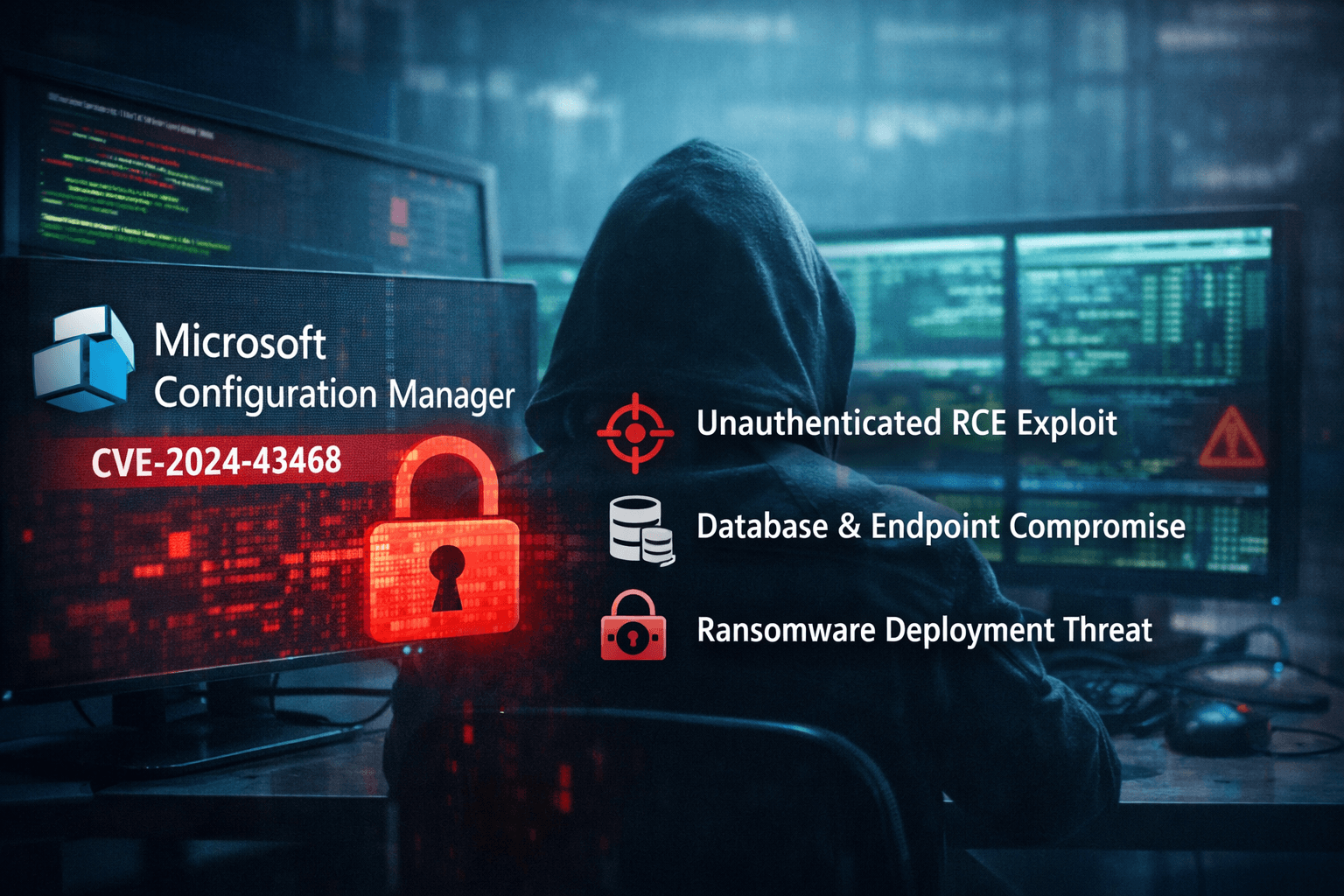
A critical vulnerability in Microsoft Configuration Manager (formerly SCCM) is sending shockwaves through enterprise IT departments. CVE-2024-43468, an unauthenticated remote code execution flaw with a CVSS score of 9.8, has been added to CISA's Known Exploited Vulnerabilities catalog after proof-of-concept code became publicly available. Attackers exploiting this vulnerability can execute arbitrary commands with high privileges on Configuration Manager servers and underlying databases—without requiring authentication.
For organizations managing thousands of Windows endpoints through ConfigMgr, this represents a critical threat to infrastructure integrity. The vulnerability affects Configuration Manager versions 2107, 2111, 2203, 2207, 2303, and 2309, potentially impacting millions of enterprise devices worldwide. With active exploitation confirmed and a PoC circulating in the wild, security teams face an urgent patching deadline.
This guide examines the technical mechanics of CVE-2024-43468, assesses real-world exploitation risks, and provides actionable mitigation strategies for IT administrators responsible for securing enterprise Windows deployments.
Understanding CVE-2024-43468: Technical Analysis
The vulnerability stems from improper input validation in the Configuration Manager administration service, allowing remote attackers to bypass authentication controls entirely.
Attack Vector and Requirements
Unlike many enterprise vulnerabilities requiring initial access or credentials, CVE-2024-43468 is an unauthenticated attack. Threat actors need only network access to the Configuration Manager administration service—typically exposed on internal networks but occasionally accessible through VPN connections or misconfigured perimeters.
The attack leverages specially crafted HTTP requests to the administration service API. By exploiting insufficient validation of serialized objects, attackers can inject malicious payloads that execute with NT AUTHORITY\SYSTEM privileges on the primary site server. This level of access provides complete control over:
- Configuration Manager database containing device inventory and credentials
- Software distribution mechanisms reaching all managed endpoints
- Operating system deployment infrastructure
- Asset intelligence and reporting systems
Impact Scope and Privilege Escalation
Once exploited, attackers gain several high-value capabilities. They can deploy malicious software packages to thousands of endpoints simultaneously, leveraging Configuration Manager's legitimate distribution channels to evade detection. The database access exposes sensitive information including network access accounts, task sequence credentials, and potentially clear-text passwords stored in configuration data.
Important: The vulnerability provides attackers with trusted infrastructure access, enabling lateral movement that appears legitimate to security monitoring tools.
Table: CVE-2024-43468 Attack Characteristics
| Attribute | Details | Risk Level |
|---|---|---|
| Authentication Required | None | Critical |
| Attack Complexity | Low | High Risk |
| Privileges Required | None | Critical |
| User Interaction | None | High Risk |
| Scope | Changed | Critical |
| Impact (CIA) | High/High/High | Maximum |
Exploitation Timeline and Threat Intelligence
Microsoft released patches in October 2024, but exploitation began shortly after a detailed proof-of-concept emerged in early November 2024. CISA's addition to the KEV catalog on November 13, 2024, confirmed active exploitation by threat actors. Security researchers observed reconnaissance activity targeting exposed Configuration Manager services, with attackers scanning for vulnerable installations across enterprise networks.
The rapid weaponization—from patch release to active exploitation in under three weeks—demonstrates the vulnerability's attractiveness to adversaries. Configuration Manager's privileged position in enterprise environments makes it a high-value target for ransomware operators, APT groups, and cybercriminals seeking persistent access.
Real-World Exploitation Scenarios
Understanding how attackers operationalize CVE-2024-43468 helps security teams prioritize defensive measures and detection capabilities.
Initial Access and Reconnaissance
Threat actors typically begin by identifying Configuration Manager infrastructure through network scanning. They target ports 80 and 443, probing for the administration service endpoint at /AdminService/v1.0/. Exposed services often reveal version information, allowing attackers to confirm vulnerability before launching exploits.
In observed campaigns, attackers performed minimal reconnaissance to avoid detection. The exploit's reliability and lack of authentication requirement mean adversaries can move directly from discovery to exploitation within minutes.
Post-Exploitation Activities
After gaining SYSTEM access, sophisticated threat actors prioritize several objectives:
- Credential harvesting: Extracting network access accounts and SQL Server credentials from the Configuration Manager database
- Persistence establishment: Creating hidden administrative accounts or deploying backdoors through legitimate deployment mechanisms
- Lateral movement preparation: Identifying high-value targets in the managed endpoint inventory
- Data exfiltration: Accessing sensitive configuration data and asset intelligence
Pro Tip: Monitor Configuration Manager audit logs for unexpected administrative service API calls, especially from unusual source IPs or during off-hours.
Ransomware Distribution Vector
Several ransomware groups have demonstrated interest in Configuration Manager as a distribution platform. By compromising ConfigMgr infrastructure, attackers can deploy ransomware payloads to thousands of endpoints simultaneously using trusted software deployment mechanisms.
This technique offers significant advantages over traditional ransomware distribution:
- Bypasses application whitelisting policies
- Leverages legitimate administrative channels
- Evades endpoint detection and response (EDR) solutions
- Enables rapid encryption across large environments
Organizations have reported complete infrastructure compromise within hours of initial exploitation, with attackers deploying ransomware to 80-90% of managed endpoints before detection.
Table: Post-Exploitation Attack Paths
| Attack Phase | Attacker Actions | Detection Opportunity |
|---|---|---|
| Initial Compromise | Exploit CVE-2024-43468 | Network monitoring for AdminService access |
| Privilege Escalation | Execute commands as SYSTEM | Process creation monitoring |
| Credential Access | Extract ConfigMgr database credentials | Database query logging |
| Lateral Movement | Deploy malicious packages | Unexpected software deployments |
| Impact | Ransomware or data theft | EDR alerts, backup deletion |
Mitigation Strategies and Remediation Steps
Addressing CVE-2024-43468 requires immediate action combined with defense-in-depth strategies to limit exposure and detect exploitation attempts.
Immediate Patching Requirements
Microsoft released security updates addressing CVE-2024-43468 for all affected Configuration Manager versions. Organizations must prioritize patching based on their current deployment:
Configuration Manager Version Update Requirements:
- Version 2309: Apply KB25858444 (released October 2024)
- Version 2303: Apply KB25858443 (released October 2024)
- Version 2207: Apply KB25858442 (released October 2024)
- Version 2203: Apply KB25858441 (released October 2024)
- Version 2111: Upgrade to supported version and patch
- Version 2107: Upgrade to supported version and patch
The patching process requires Configuration Manager primary site server updates followed by console updates for all administrators. Plan for potential service interruptions during the update process, though most organizations can patch during maintenance windows without significant downtime.
Network Segmentation and Access Controls
While patching eliminates the vulnerability, layered security controls reduce attack surface and limit blast radius:
- Restrict Configuration Manager administration service access to designated management networks
- Implement network-based intrusion prevention systems (IPS) with signatures detecting exploitation attempts
- Deploy multi-factor authentication for all administrative access to Configuration Manager consoles
- Establish jump servers or privileged access workstations for ConfigMgr administration
- Monitor and log all API calls to the administration service endpoint
Table: Defense-in-Depth Controls
| Control Layer | Implementation | Effectiveness |
|---|---|---|
| Network | Segment ConfigMgr infrastructure | High |
| Authentication | MFA for all admin access | High |
| Monitoring | SIEM integration for ConfigMgr logs | Medium |
| Detection | IPS signatures for CVE-2024-43468 | Medium |
| Response | Automated incident response playbooks | High |
Detection and Monitoring Capabilities
Implementing robust detection mechanisms helps identify exploitation attempts and post-compromise activities:
Enable Configuration Manager audit logging at maximum verbosity, focusing on administrative service access patterns. Configure SIEM alerts for unusual API calls, especially authentication bypass attempts or unexpected administrative actions from non-standard sources.
Monitor for indicators of compromise including:
- Unexpected software deployments or modified packages
- New administrative accounts or permission changes
- Unusual database queries against the Configuration Manager database
- Process creation events showing suspicious command-line parameters
- Network connections from ConfigMgr servers to external destinations
Deploy endpoint detection and response (EDR) solutions on Configuration Manager infrastructure with enhanced monitoring for exploitation indicators. Many EDR vendors released specific detection rules for CVE-2024-43468 exploitation attempts following CISA's KEV listing.
Incident Response Preparation
Organizations should prepare incident response procedures specifically for Configuration Manager compromise scenarios:
- Document Configuration Manager infrastructure topology and dependencies
- Establish backup Configuration Manager servers for emergency operations
- Create offline backups of Configuration Manager databases and configuration data
- Develop procedures for emergency software deployment suspension
- Test restoration processes from known-good backups
If exploitation is suspected, immediately isolate affected Configuration Manager servers from the network while maintaining endpoint management capabilities through secondary infrastructure. Conduct thorough forensic analysis before restoration to ensure complete attacker removal.
Compliance and Regulatory Implications
The CVE-2024-43468 vulnerability carries significant compliance ramifications for organizations in regulated industries.
CISA KEV Catalog Requirements
CISA's inclusion of CVE-2024-43468 in the Known Exploited Vulnerabilities catalog triggers binding operational directives for federal agencies. Under BOD 22-01, Federal Civilian Executive Branch (FCEB) agencies must remediate KEV-listed vulnerabilities within prescribed timelines—typically 14 to 21 days from catalog addition.
While private sector organizations aren't bound by BOD 22-01, the KEV listing signals active exploitation and elevated risk. Many cyber insurance policies and security frameworks reference the KEV catalog as a benchmark for due diligence in vulnerability management.
Framework Alignment and Audit Considerations
Several security frameworks address critical vulnerability management requirements that apply to CVE-2024-43468:
NIST Cybersecurity Framework: The Identify and Protect functions require organizations to maintain vulnerability management programs with risk-based prioritization. KEV-listed vulnerabilities demand immediate attention under the Respond function.
ISO 27001:2022: Controls 8.8 (Management of technical vulnerabilities) and 5.14 (Information security in supplier relationships) establish requirements for timely vulnerability remediation, especially for actively exploited flaws in critical infrastructure.
CIS Controls: Control 7 (Continuous Vulnerability Management) specifically addresses remediation timelines for critical vulnerabilities, with sub-controls requiring automated scanning and risk-based prioritization.
Organizations undergoing SOC 2 Type II audits should document CVE-2024-43468 patching timelines and compensating controls if immediate remediation wasn't feasible. Auditors increasingly scrutinize vulnerability management processes, particularly for KEV-listed issues.
Data Breach Notification Obligations
If CVE-2024-43468 exploitation leads to unauthorized access to protected data, organizations face notification obligations under various regulations:
- GDPR: Article 33 requires breach notification within 72 hours of awareness
- HIPAA: Covered entities must report breaches affecting 500+ individuals
- State laws: All 50 US states have breach notification requirements with varying timelines
Configuration Manager databases often contain personally identifiable information (PII) through asset inventory data. Organizations must assess data exposure and notification requirements if exploitation is confirmed.
Key Takeaways
- Patch immediately: CVE-2024-43468 is actively exploited with public PoC code—apply Microsoft's updates across all affected Configuration Manager versions without delay
- Implement network segmentation: Isolate Configuration Manager infrastructure from general corporate networks and restrict administration service access to designated management zones
- Enable comprehensive logging: Configure detailed audit trails for Configuration Manager administrative activities and integrate logs with SIEM platforms for threat detection
- Prepare incident response: Develop and test procedures specifically for Configuration Manager compromise scenarios, including emergency deployment suspension and forensic analysis workflows
- Verify compliance alignment: Document remediation efforts and compensating controls for audit purposes, especially if operating in regulated industries
- Monitor for exploitation indicators: Deploy detection capabilities targeting CVE-2024-43468 exploitation attempts and post-compromise activities unique to Configuration Manager environments
Conclusion
CVE-2024-43468 represents a critical threat to enterprise Windows infrastructure, combining ease of exploitation with high-impact consequences. The vulnerability's inclusion in CISA's Known Exploited Vulnerabilities catalog and confirmed active exploitation demand immediate action from security teams managing Configuration Manager deployments.
Organizations must prioritize patching while implementing defense-in-depth controls to limit exposure and enable rapid detection. The privileged position of Configuration Manager in enterprise environments makes it an attractive target for sophisticated threat actors, ransomware operators, and APT groups seeking persistent access to corporate networks.
Beyond immediate remediation, this incident underscores the importance of comprehensive vulnerability management programs, network segmentation strategies, and robust monitoring capabilities. Security teams should review Configuration Manager security postures holistically, addressing not just CVE-2024-43468 but also broader architectural weaknesses that could enable similar exploitation attempts.
Take action now: verify your Configuration Manager version, apply appropriate patches, and validate that security controls are effectively protecting your enterprise infrastructure against this critical vulnerability.
Frequently Asked Questions
Q: How can I determine if my Configuration Manager environment has been exploited through CVE-2024-43468?
A: Review Configuration Manager audit logs for unusual administrative service API calls, especially from unexpected source IPs or during off-hours. Check for unexpected software deployments, new administrative accounts, or modified security permissions. Deploy endpoint detection tools on ConfigMgr servers and scan for indicators of compromise associated with known exploitation techniques. If suspicious activity is detected, engage forensic specialists to conduct a thorough investigation before proceeding with remediation.
Q: What is the recommended patching timeline for CVE-2024-43468 given its KEV catalog inclusion?
A: Organizations should treat this as a critical priority requiring immediate action—ideally within 48-72 hours of awareness. Federal agencies under BOD 22-01 must remediate within CISA's specified deadline (typically 14-21 days from KEV listing). Private sector organizations should follow their vulnerability management policies but recognize that active exploitation and public PoC availability warrant expedited patching. If immediate patching isn't feasible, implement compensating controls like network segmentation and enhanced monitoring while prioritizing the update.
Q: Can the administration service be disabled temporarily as a mitigation if patching is delayed?
A: Disabling the Configuration Manager administration service is not recommended as it breaks critical management functionality including the ConfigMgr console, PowerShell cmdlets, and third-party management tools. Instead, implement network-level access controls restricting administration service access to designated management networks and IP addresses. Deploy intrusion prevention systems with signatures detecting CVE-2024-43468 exploitation attempts. These compensating controls provide protection while maintaining operational capabilities until patches can be applied.
Q: Does this vulnerability affect Configuration Manager cloud management gateway (CMG) deployments?
A: The primary vulnerability affects on-premises Configuration Manager infrastructure, specifically the administration service on primary site servers. However, hybrid environments with cloud management gateways should verify their security posture comprehensively. If the CMG is connected to vulnerable on-premises infrastructure, compromise of the primary site server could potentially impact cloud-connected clients. Review CMG authentication configurations and network segmentation between on-premises and cloud components as part of your security assessment.
Q: What compliance reporting is required after remediating CVE-2024-43468?
A: Documentation requirements vary by industry and applicable frameworks. At minimum, maintain records of patch deployment dates, affected systems, and validation testing results. For SOC 2 audits, document the vulnerability management process including discovery, risk assessment, remediation timeline, and verification procedures. Organizations in healthcare or financial services should review sector-specific reporting requirements. If exploitation occurred and resulted in data access, consult legal counsel regarding breach notification obligations under GDPR, HIPAA, or applicable state laws.

Enjoyed this article?
Subscribe for more cybersecurity insights.