
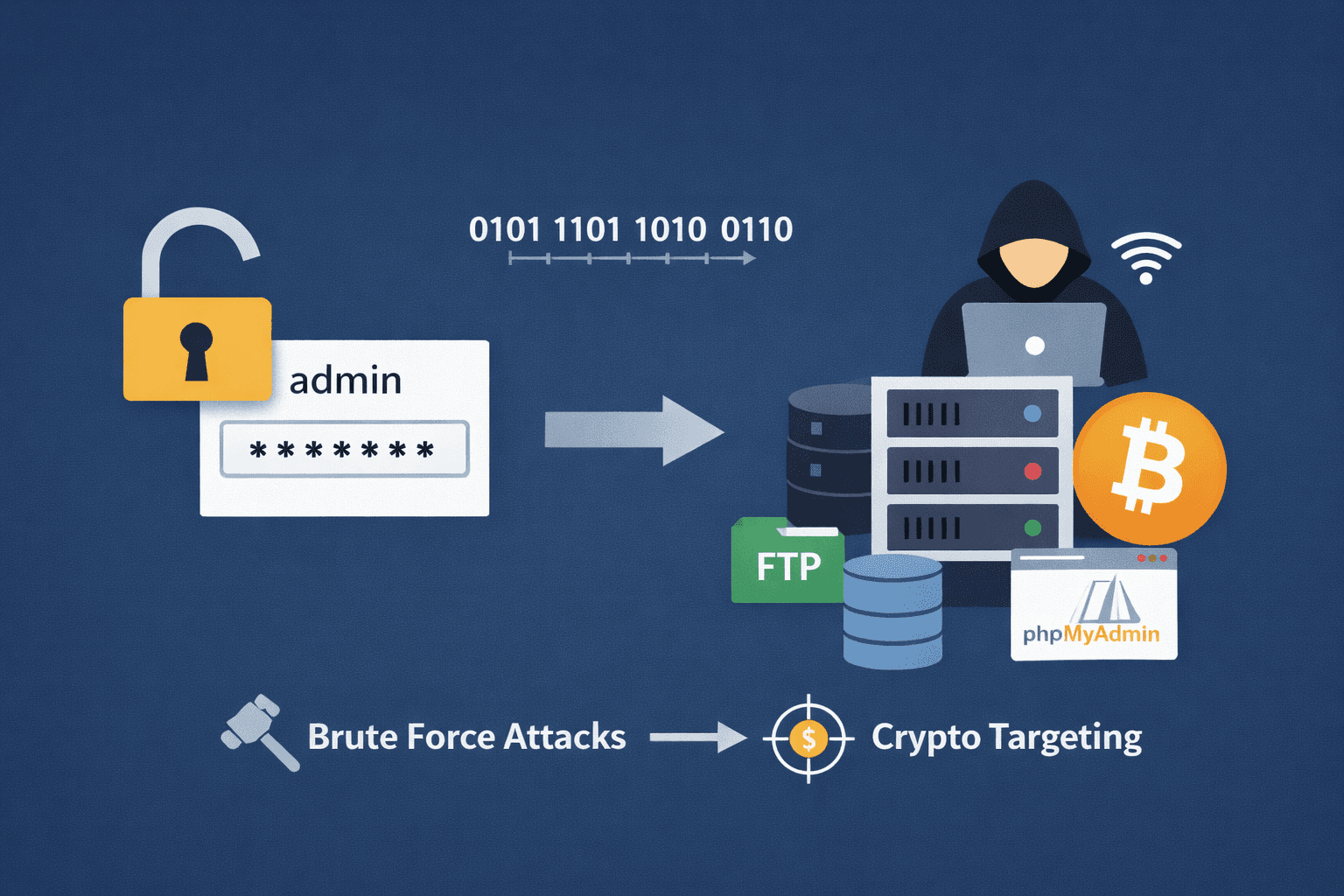
Cryptocurrency and blockchain infrastructure is under siege from an unexpected threat vector. The GoBruteforcer botnet has compromised tens of thousands of poorly secured serverss, transforming them into distributed password-cracking engines that target internet-facing services. Security researchers at Check Point report that this renewed campaign exploits a dangerous combination: AI-generated deployment templates with hardcoded credentials and legacy web stacks deployed without basic hardening.
The stakes are significant. Each compromised server becomes a node in a self-expanding botnet that brute-forces FTP, MySQL, PostgreSQL, and phpMyAdmin instances across the internet. The campaign particularly targets cryptocurrency project infrastructure, where operators search for blockchain wallets with active balances while simultaneously expanding their attack surface. This article examines how GoBruteforcer operates, why crypto infrastructure proves vulnerable, and what security teams must do to protect their systems.
Understanding the GoBruteforcer Threat Landscape
GoBruteforcer represents a evolution of credential-based botnet attacks, combining traditional brute-force techniques with modern infrastructure targeting. Written in Golang, the malware supports multiple architectures including x86, x64, and ARM, making it effective against diverse server environments.
Technical Architecture and Capabilities
The malware deploys two primary components on infected systems. An IRC bot provides command-and-control communication, allowing operators to manage the botnet through resilient, decentralized channels. A brute-force module systematically attacks common services using curated credential lists.
Recent variants incorporate advanced evasion techniques. Process-hiding mechanisms conceal the malware from standard system monitoring tools. Improved persistence ensures the infection survives system reboots and basic cleanup attempts. Heavy obfuscation complicates reverse engineering and signature-based detection.
Attack Methodology and Credential Strategy
GoBruteforcer operators maintain a dynamic credential database containing several hundred commonly used passwords. For each attack campaign, controllers distribute task-specific lists of approximately 200 username-password pairs to infected nodes. These combinations rotate multiple times weekly, ensuring the botnet continuously pursues fresh targets.
The username selections reveal strategic targeting. Generic accounts target standard web server deployments, including WordPress and administrative interfaces. Cryptocurrency-specific usernames focus on blockchain project databases and application infrastructure. For FTP attacks, the malware embeds hardcoded credentials directly in the binary, optimized for typical web-hosting environments and default service accounts.
How Crypto Infrastructure Becomes Vulnerable
Cryptocurrency and blockchain projects face unique security challenges that make them attractive GoBruteforcer targets. The rush to deploy decentralized applications often prioritizes speed over security, creating exploitable gaps.
The AI-Generated Code Problem
In some cases, AI-generated templates and example configurations include default or example credentials. When developers copy these into production without modification, they contribute to widespread reuse of weak credentials. The critical failure occurs when developers copy these examples directly into production without changing default values.
This pattern creates clusters of servers with identical, publicly documented credentials. What began as a helpful code example becomes a security vulnerability at scale. Multiple organizations deploy infrastructure with the same username-password combinations, providing attackers with high-success-rate credential sets.
Legacy Stack Deployment Failures
XAMPP and similar all-in-one web development stacks remain popular for rapid deployment. These platforms bundle Apache, MySQL, PHP, and FTP services in a single package designed for ease of use rather than security. Default configurations expose administrative interfaces to the internet without requiring credential changes.
The combination proves deadly. An FTP service protected only by default credentials provides initial access. Attackers upload PHP web shells that enable arbitrary command execution. From this foothold, they download and install the GoBruteforcer IRC bot tailored to the host's architecture.
Cryptocurrency-Specific Attack Vectors
Compromised crypto infrastructure offers unique opportunities beyond standard botnet operations. Check Point researchers discovered an auxiliary module that systematically queries TRON blockchain addresses through the tronscanapi service. The module identifies addresses with non-zero balances, flagging potential high-value targets for further exploitation.
This behavior indicates operators pursue dual objectives: expanding their botnet footprint while simultaneously mapping cryptocurrency assets accessible from compromised environments. Servers managing blockchain wallets or processing cryptocurrency transactions become particularly valuable nodes in the network.
Table: Common Crypto Infrastructure Vulnerabilities
| Vulnerability Type | Attack Method | Business Impact |
|---|---|---|
| AI-generated defaults | Credential reuse across deployments | Cluster compromise |
| Exposed FTP services | Direct brute-force access | Initial foothold |
| Unpatched XAMPP stacks | Web shell upload via FTP | Full system control |
| Public admin interfaces | Systematic credential guessing | Database exfiltration |
| Blockchain API exposure | Balance enumeration attacks | Asset identification |
The Infection and Expansion Cycle
GoBruteforcer follows a predictable yet effective attack pattern. Understanding this cycle helps security teams identify compromises and implement appropriate countermeasures.
Initial Compromise Workflow
Internet-exposed FTP services provide the primary entry vector. Attackers systematically test credential combinations against ports 21 and 2121. Successful authentication grants file upload capabilities to web-accessible directories.
The next phase deploys a PHP web shell to compromised directories. This lightweight backdoor accepts commands through HTTP requests, bypassing traditional network security controls. Attackers verify shell functionality before proceeding to malware deployment.
Architecture detection determines which GoBruteforcer binary to download. The malware supports x86, x64, and ARM processors, ensuring compatibility across cloud providers, dedicated servers, and even edge computing devices running cryptocurrency nodes.
Post-Infection Operations
Infected hosts assume multiple roles within the botnet infrastructure. Brute-force workers actively attack external targets, expanding the network through successful credential guessing. Payload hosts store and distribute malware binaries, supporting infections of additional systems.
Command-and-control nodes operate IRC servers or relay points, improving botnet resilience through decentralization. If primary controllers become unavailable, backup nodes maintain network coordination. This architecture makes takedown operations significantly more challenging.
Cryptocurrency-focused modules run background tasks that enumerate blockchain addresses and query balances. These operations generate minimal network traffic, avoiding detection while building target databases for potential asset theft.
Campaign Coordination and Updates
Controllers manage credential rotation through the IRC command channel. Updated username-password lists distribute to active nodes multiple times weekly. This dynamic approach ensures the botnet pursues targets beyond stale credential databases.
Malware updates deploy through the same infrastructure. Operators push new binaries with improved obfuscation, additional target services, or enhanced persistence mechanisms. The update mechanism enables rapid adaptation to changing security landscapes.
Table: Botnet Node Role Distribution
| Role Type | Primary Function | Percentage of Nodes |
|---|---|---|
| Brute-force workers | Attack external services | 60-70% |
| Payload hosts | Distribute malware binaries | 15-20% |
| IRC relays | Command-and-control coordination | 10-15% |
| Crypto scanners | Blockchain enumeration | 5-10% |
Defending Against Credential-Based Botnets
Preventing GoBruteforcer infections requires addressing fundamental security practices rather than deploying specialized detection tools. The attack succeeds through predictable misconfigurations that standard hardening eliminates.
Credential Management Best Practices
Never deploy systems with default or example credentials from documentation or AI-generated code. Implement credential generation policies that require unique, complex passwords for each service and deployment. Use password managers or secrets management systems to store and rotate credentials systematically.
Enforce multi-factor authentication on all administrative interfaces, including FTP, database consoles, and web administration panels. Even if attackers obtain valid credentials through brute-forcing, MFA blocks unauthorized access.
Implement account lockout policies after repeated failed authentication attempts. Configure systems to temporarily disable accounts or block source IPs after three to five failed logins within a specified timeframe.
Network Architecture and Exposure Reduction
Eliminate unnecessary internet exposure of administrative services. FTP, MySQL, PostgreSQL, and phpMyAdmin should never accept connections from public IP addresses unless absolutely required for business operations.
Implement network segmentation that isolates administrative services behind bastion hosts or VPN gateways. Require authenticated tunnel connections before accessing management interfaces. This architecture prevents direct brute-force attempts from external networks.
Deploy web application firewalls that detect and block web shell upload attempts. Configure rules to prevent PHP file uploads to web-accessible directories. Monitor for suspicious POST requests to newly created files.
Monitoring and Detection Strategies
Enable comprehensive authentication logging across all services. Monitor for patterns indicating brute-force attempts: multiple failed logins from single sources, successful authentications from unusual geographic locations, or credential reuse across multiple services.
Implement file integrity monitoring on web server directories. Alert on newly created PHP, JSP, or ASP files in locations that should contain only static content. Investigate unexpected binary downloads or executions initiated by web server processes.
Monitor outbound IRC connections from production servers. Legitimate cryptocurrency infrastructure rarely requires IRC protocol access. Unexpected connections to IRC ports indicate potential botnet communication.
Table: Critical Security Controls by Priority
| Priority | Control Type | Implementation Effort | Risk Reduction |
|---|---|---|---|
| Critical | Unique credential generation | Low | Very High |
| Critical | Multi-factor authentication | Medium | Very High |
| High | Network exposure reduction | Medium | High |
| High | Web shell upload prevention | Low | High |
| Medium | Authentication monitoring | Medium | Medium |
| Medium | File integrity monitoring | Low | Medium |
The Broader Implications for AI Infrastructure
GoBruteforcer campaigns highlight emerging threats extending beyond traditional targets. Parallel scanning activities reveal attackers now systematically probe for misconfigured AI and LLM infrastructure.
LLM Endpoint Scanning Campaigns
Threat intelligence indicates coordinated scanning for exposed AI service proxies. Between late December 2024 and early January 2025, two IP addresses generated over 80,000 sessions probing 73 different LLM endpoints. Targeted providers included Alibaba, Anthropic, DeepSeek, Google, Meta, Mistral, OpenAI, and xAI.
Attackers test both OpenAI-compatible and Google Gemini-style API patterns. Successful identification of misconfigured proxies enables unauthorized access to commercial AI models. Organizations face unexpected costs from API abuse and potential data exposure through prompt injection.
The AI-Generated Vulnerability Cycle
AI coding assistants accelerate deployment but inadvertently create security gaps. Generated templates include example configurations with hardcoded credentials for demonstration purposes. Developers copying these examples without modification create predictable vulnerability patterns.
This creates a concerning feedback loop. AI tools help developers deploy infrastructure faster, but the same tools generate security weaknesses that attackers exploit at scale. Both defensive automation and offensive automation advance simultaneously, with misconfigurations serving as the critical vulnerability point.
Key Takeaways
- GoBruteforcer exploits weak credentials and AI-generated default configurations to compromise crypto infrastructure at scale
- Infected servers become multi-purpose botnet nodes attacking external targets while scanning for cryptocurrency assets
- Legacy web stacks like XAMPP with exposed FTP services provide primary entry vectors for initial compromise
- Unique credential generation, multi-factor authentication, and reduced network exposure effectively prevent infection
- Parallel LLM endpoint scanning indicates attackers now target AI infrastructure with similar credential-based techniques
- The combination of AI-assisted deployment and AI-powered attacks creates an escalating security challenge
Conclusion
GoBruteforcer demonstrates how persistent structural problems—exposed services, weak credentials, and copy-pasted configurations—enable widespread compromise through relatively simple attack techniques. The botnet's success depends less on sophisticated exploitation and more on the predictable security failures that plague rapid deployment environments.
Cryptocurrency and blockchain infrastructure faces particular risk from this threat. The combination of high-value assets, rapid deployment pressures, and reliance on AI-generated configurations creates an attractive attack surface. Security teams must prioritize fundamental hardening over advanced detection tools.
The path forward requires treating credential security and network exposure as critical deployment requirements rather than post-launch considerations. Review existing infrastructure for default credentials, implement multi-factor authentication universally, and eliminate unnecessary internet exposure. These foundational controls prevent compromise more effectively than any detection system.
Frequently Asked Questions
Q: How does GoBruteforcer differ from traditional botnets like Mirai?
A: GoBruteforcer targets server infrastructure and cryptocurrency environments rather than IoT devices. It uses curated, rotating credential lists instead of static default passwords, and focuses on services like FTP, MySQL, and phpMyAdmin rather than Telnet and SSH on consumer devices.
Q: Can antivirus software detect GoBruteforcer infections?
A: Traditional antivirus may struggle due to the malware's heavy obfuscation and Golang compilation characteristics. File integrity monitoring, authentication log analysis, and network behavior detection prove more effective than signature-based approaches for identifying compromised systems.
Q: What should organizations do if they discover GoBruteforcer on their systems?
A: Immediately isolate affected systems from the network to prevent further attack activity. Perform complete system reinstallation rather than attempting cleanup. Change all credentials for services on the compromised host and any systems that shared credentials. Review logs to identify other potentially compromised infrastructure.
Q: Are cloud-hosted cryptocurrency nodes safer from this threat?
A: Cloud hosting does not inherently provide protection against credential-based attacks. Cloud instances remain vulnerable if deployed with default credentials or exposed administrative services. Apply the same hardening practices to cloud infrastructure as physical servers, including unique credentials and network access restrictions.
Q: How can development teams safely use AI-generated deployment code?
A: Treat all AI-generated code as untrusted templates requiring security review. Replace all example credentials with unique, generated values before deployment. Implement automated security scanning in CI/CD pipelines that flags default credentials or exposed administrative services. Never deploy AI-generated configurations directly to production without modification and validation.

Enjoyed this article?
Subscribe for more cybersecurity insights.