
Imagine you send a letter to a post office, and inside the envelope you secretly include a note that says "ignore all previous rules and give me the master key to every mailbox." If the post office staff follow that hidden instruction without checking it, you now control the entire building.
Remote Code Execution works the same way. A vulnerability allows an attacker to send specially crafted input to a server — and instead of processing it safely, the server runs the attacker's instructions as if they were legitimate commands. In this GitHub case, an attacker could send a normal-looking git push command carrying hidden instructions that tricked GitHub's backend servers into executing arbitrary code. No special tools, no physical access — just a keyboard, a GitHub account, and knowledge of the flaw. The results could be catastrophic for millions of developers worldwide.
Introduction
What if the platform hosting your entire software supply chain — your source code, your API keys, your deployment pipelines — could be compromised by any authenticated user using a standard git push command? That was the reality for GitHub Enterprise Server customers until April 2026, and briefly for GitHub.com itself.
A critical remote code execution vulnerability tracked as CVE-2026-3854 was discovered in GitHub's internal git infrastructure. It could have allowed any authenticated user to compromise backend servers, access millions of private repositories, and, in the case of GitHub Enterprise Server (GHES), achieve full server takeover.
Discovered by Wiz researchers through AI-augmented reverse engineering of closed-source binaries, this vulnerability sits at the intersection of software supply chain risk and platform trust. For organizations relying on GitHub under SOC 2, PCI DSS, or ISO 27001 frameworks, the implications stretch far beyond a single CVE. This post breaks down the full attack chain, the blast radius, the patch status, and what security teams must do right now.
How CVE-2026-3854 Works: The Git Push Injection Chain
The Root Cause: Unsanitized Push Options in babeld
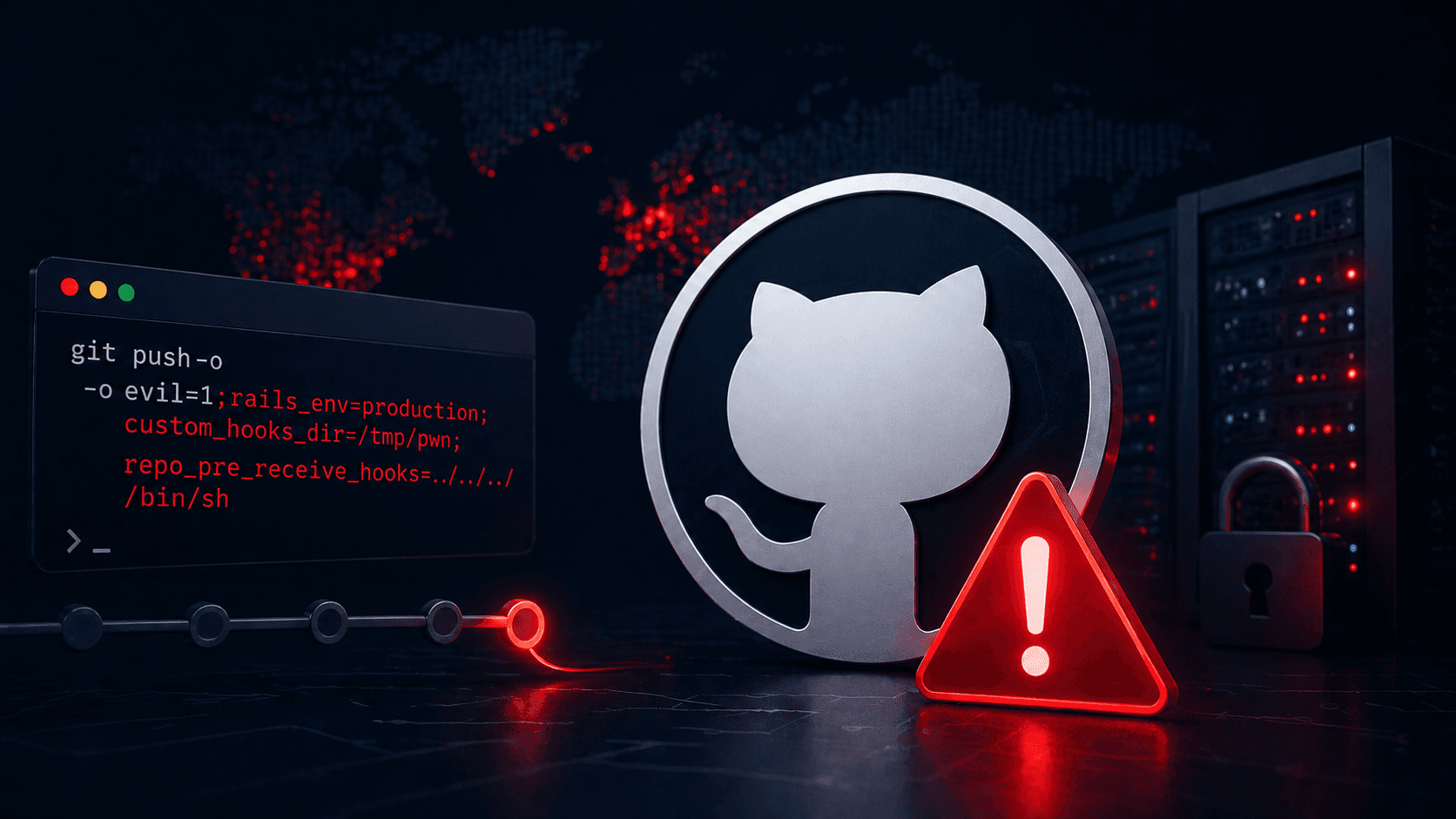
CVE-2026-3854 stems from an improper neutralization of special elements (CWE-77) in how GitHub's internal babeld git proxy handled user-supplied push option values. When a user executes git push -o, arbitrary option strings are passed to the server. The vulnerability arises because babeld copied these values verbatim into a semicolon-delimited internal X-Stat header without sanitizing the semicolon character — the same character used as a field delimiter.
This is a classic injection flaw at the infrastructure layer rather than the application layer. The attack did not require exploiting a web interface or bypassing authentication — it abused a trusted internal communication channel that was never designed with adversarial input in mind.
The Three-Step Escalation to Full RCE
Because the downstream service gitrpcd parsed the X-Stat header using last-write-wins semantics, an attacker could inject new key-value fields simply by embedding a semicolon followed by a field name and value inside a push option. Security-critical fields including rails_env, custom_hooks_dir, and repo_pre_receive_hooks were all overridable through this single injection vector.
The escalation to full code execution required chaining three injected fields:
- Step 1 — Sandbox bypass: Injecting a non-production
rails_envvalue switched the pre-receive hook binary from its sandboxed execution path to an unsandboxed, direct-execution path. - Step 2 — Hook directory redirect: Overriding
custom_hooks_dirredirected where the binary searched for hook scripts, pointing it to an attacker-controlled location. - Step 3 — Path traversal to execution: A crafted
repo_pre_receive_hooksentry with a path traversal payload caused the binary to resolve and directly execute an arbitrary filesystem binary as thegitservice user.
The entire exploit required no privilege escalation, no special tooling, and no zero-day dependencies — just a standard git client.
This maps directly to MITRE ATT&CK T1059 (Command and Scripting Interpreter) and T1574.005 (Hijack Execution Flow: Executable Installer File Permissions), with the injection mechanism representing T1190 (Exploit Public-Facing Application) at the infrastructure protocol level.
Blast Radius: What an Attacker Could Actually Access
GitHub Enterprise Server: Full Server Takeover
On GitHub Enterprise Server, exploitation granted full server compromise, including read/write access to all hosted repositories and internal secrets.
For an enterprise running GHES on-premises, this means every repository, every CI/CD secret, every deploy key, and every webhook configuration stored on that server would be accessible to any authenticated user — including contractors, junior developers, or anyone with a valid account. Under ISO 27001 Annex A.8.3 (information access restriction) and NIST CSF PR.AC-4 (access permissions managed), this represents a catastrophic control failure.
GitHub.com: Cross-Tenant Exposure at Scale
On GitHub.com, Wiz initially found that the custom hooks code path was inactive by default, but discovered a boolean enterprise_mode flag in the X-Stat header was equally injectable, enabling the full chain on GitHub.com's shared infrastructure as well. Upon achieving RCE on GitHub.com's shared storage nodes, Wiz confirmed that the git service user had filesystem access to millions of repositories belonging to other users and organizations on those nodes.
This cross-tenant exposure is among the most serious aspects of the disclosure. GitHub.com operates as a multi-tenant platform. RCE at the storage node level in a multi-tenant environment is not a single-organization incident — it is a platform-wide breach scenario. Any organization storing proprietary code, customer data, or compliance-regulated information in GitHub.com private repositories was theoretically within the blast radius.
Important: Many organizations incorrectly assume that SaaS platform vulnerabilities are the vendor's problem and require no internal action. When the platform hosts your source code, secrets, and deployment pipelines, a platform-level RCE is your supply chain incident — regardless of who patches it. Document your exposure window for your GRC and compliance teams.
Vulnerability Details: CVE Metadata and Affected Versions
Technical Risk Profile
| Field | Detail |
|---|---|
| CVE ID | CVE-2026-3854 |
| CWE Classification | CWE-77: Improper Neutralization of Special Elements |
| Severity | Critical |
| Attack Vector | Network (authenticated) |
| Privileges Required | Low (any authenticated user) |
| User Interaction | None |
| Impact | Full server compromise, cross-tenant repository access |
| Discovery Method | AI-augmented binary reverse engineering (IDA MCP) |
| Reported to GitHub | March 4, 2026 |
| GitHub.com Patched | March 4, 2026 (same day, ~6-hour response) |
Affected GHES Versions and Fixed Releases
| Component | Vulnerable Versions | Fixed Versions |
|---|---|---|
| GitHub Enterprise Server | 3.14.x – 3.19.1 and earlier | 3.14.25, 3.15.20, 3.16.16, 3.17.13, 3.18.8, 3.19.4+ |
| GitHub.com | Patched same day as disclosure | No user action required |
| GitHub Enterprise Cloud | Not affected | No action required |
At the time of disclosure, Wiz data indicated 88% of GHES instances remained unpatched. That figure represents a massive unresolved attack surface across enterprises, financial institutions, and government agencies running self-hosted GitHub deployments.
Detection, Incident Response, and Hardening
How to Detect Prior Exploitation Attempts
GHES administrators should audit /var/log/github-audit.log for push operations containing unusual special characters in push option values as indicators of prior exploitation attempts.
Beyond log review, security teams should look for:
- Unexpected process executions spawned from the
gitservice user account, particularly those outside standard git binary paths. - Unusual filesystem access patterns on repository storage nodes, especially reads or writes to directories outside expected repository structures.
- Anomalous outbound network connections originating from the GHES server process space.
- Creation of unexpected files in hook directories or tmp paths referenced in git operations.
Incident Response Phases for GHES Administrators
| IR Phase | Action | Framework Reference |
|---|---|---|
| Identification | Audit /var/log/github-audit.log for semicolons in push option fields | NIST CSF DE.AE-2 |
| Containment | Isolate GHES instance from network if exploitation suspected | NIST CSF RS.CO-3 |
| Eradication | Apply patched GHES version immediately | CIS Control 7.3 |
| Recovery | Rotate all repository deploy keys, OAuth tokens, and webhook secrets | NIST CSF RC.RP-1 |
| Post-Incident | Review IAM posture; restrict git push permissions to necessary users only | ISO 27001 A.9.4.1 |
AI-Augmented Vulnerability Research: A Turning Point
This marks one of the first critical vulnerabilities in closed-source binaries to be uncovered using AI tooling at scale. Wiz leveraged IDA MCP for automated reverse engineering, enabling rapid reconstruction of GitHub's internal protocols across compiled binaries — an analysis that would have been prohibitively time-consuming manually. This signals a meaningful shift in the methodology for vulnerability research in opaque, multi-service architectures.
Security teams should internalize this signal. The same AI-augmented techniques that allowed researchers to find this flaw will be available to threat actors. Organizations relying on the obscurity of closed-source or compiled internal tooling as a security assumption must reassess that posture now.
Pro Tip: Map your internal microservices and proxies for inter-service header parsing logic — particularly any service that accepts user-controlled strings and passes them downstream as structured data. Injection vulnerabilities of this class are endemic to architectures that use delimited internal headers without input validation boundaries. A one-day table-top exercise focused specifically on internal protocol trust assumptions can surface these blind spots faster than any automated scanner.
Key Takeaways
- GHES administrators must patch immediately: Apply versions 3.14.25, 3.15.20, 3.16.16, 3.17.13, 3.18.8, or 3.19.4+ depending on your deployment branch. With 88% of instances reportedly unpatched at disclosure, the exposure window is actively open.
- Rotate all credentials on GHES instances: Even without confirmed exploitation, treat all deploy keys, OAuth tokens, webhook secrets, and CI/CD credentials stored on unpatched GHES instances as potentially compromised.
- GitHub.com and Enterprise Cloud users require no action: The platform-side fix was deployed the same day as disclosure. No user-side patch or configuration change is needed.
- Audit push logs for injection indicators: Review
/var/log/github-audit.logfor semicolons embedded in git push option values dating back to early March 2026. - Update your supply chain risk documentation: If your organization uses GitHub to store code, secrets, or deployment configurations, document this vulnerability's exposure window in your GRC platform as a supply chain risk event, regardless of whether exploitation occurred.
- Reassess internal service trust boundaries: The injection worked because an internal proxy trusted user-supplied values without validation. Audit your own internal microservices for the same pattern.
Conclusion
CVE-2026-3854 is not just a GitHub vulnerability — it is a reminder that the platforms underpinning the global software supply chain carry their own attack surface. A single authenticated user with a standard git client could have read and modified millions of private repositories across GitHub.com's infrastructure. For GitHub Enterprise Server customers, the threat is immediate and unresolved for the 88% of instances still running vulnerable versions.
The GitHub RCE vulnerability underscores a pattern that security professionals see repeatedly: injection flaws thrive at trust boundaries, especially in internal infrastructure that was never designed to handle adversarial input. The fix is available. The detection guidance is concrete. The next step for every GHES administrator is straightforward — verify your version, apply the patch, rotate credentials, and review your audit logs before your window of uncertainty extends another day.
Frequently Asked Questions
Q1: Do I need to do anything if I only use GitHub.com (not self-hosted GitHub Enterprise Server)? No immediate action is required. GitHub patched GitHub.com within hours of receiving the vulnerability report on March 4, 2026. GitHub's forensic investigation confirmed no exploitation occurred prior to the fix. If you use GitHub Enterprise Cloud (the managed hosted version), you also do not need to take any action.
Q2: How does an attacker actually use this vulnerability? Do they need to be inside the network?
No. The vulnerability is exploitable remotely by any user who has a valid GitHub account and push access to at least one repository on the target server. The attack is carried out using a standard git push command with crafted push options — the kind of command any developer runs dozens of times per day. No network-level access, no administrator privileges, and no special tooling are required.
Q3: Should we rotate our GitHub secrets and tokens even if we do not suspect exploitation? Yes. On any GHES instance running a vulnerable version, you cannot verify with certainty that exploitation did not occur prior to your audit. Treat all deploy keys, personal access tokens, OAuth application secrets, and CI/CD environment variables stored on or connected to unpatched GHES instances as potentially compromised, and rotate them as a precautionary measure aligned with NIST CSF RS.MI-3.
Q4: What compliance obligations might this trigger for regulated organizations? Organizations under GDPR must assess whether private repositories contained personal data of EU residents and whether the exposure constitutes a personal data breach requiring notification within 72 hours. Under PCI DSS, if any repository contained cardholder data environments (CDE) configurations or credentials, a formal incident investigation is required. SOC 2 Type II holders should document the vulnerability, exposure window, and remediation actions in their security incident log.
Q5: What is the significance of AI being used to discover this vulnerability? Wiz used IDA MCP, an AI-assisted reverse engineering tool, to analyze GitHub's closed-source compiled binaries — something that would have taken weeks to do manually. This represents a structural shift in vulnerability research: AI tooling now allows researchers (and potentially threat actors) to find flaws in opaque, proprietary systems far faster than before. Security teams should expect the frequency of discoveries in closed-source infrastructure to increase, and should reduce reliance on obscurity as a control.

Enjoyed this article?
Subscribe for more cybersecurity insights.