
Automotive Forensics 2026: Extracting Digital Evidence From Connected Vehicles
A vehicle's onboard systems recorded the exact speed, steering angle, brake force, door opening sequence, paired Bluetooth devices, GPS waypoints, and last 47 text messages — all timestamped to the millisecond — for the 90 seconds before a fatal collision. The driver's smartphone showed nothing. The dashcam had no footage. The only complete evidence record lived inside the car. Modern cars store thousands of data points every day. Their onboard computers log every start, stop, GPS location, trunk opening, door opening, cell phone call, text and more — and once a cell phone is synced with onboard computers, its data is shared with the vehicle including SMS messages, emails, pictures, videos, and social media feeds.
Connected vehicle forensics is one of the fastest-growing and least-understood DFIR disciplines in 2026. This blog explains exactly what evidence modern vehicles contain, how to extract it forensically, and where the legal and technical limits lie.
The Connected Vehicle as a Crime Scene Evidence Repository
What Modern Vehicles Record
Modern vehicles are rich repositories of digital evidence holding vital clues for accident reconstruction, criminal investigations, insurance fraud, and cybersecurity breaches. Investigators learn to navigate proprietary vehicle architectures, decipher CAN bus communications, extract GPS data, call logs, paired device information, and event data recorder insights.
The scale of vehicle data in 2026 is staggering. A single connected vehicle generates data across:
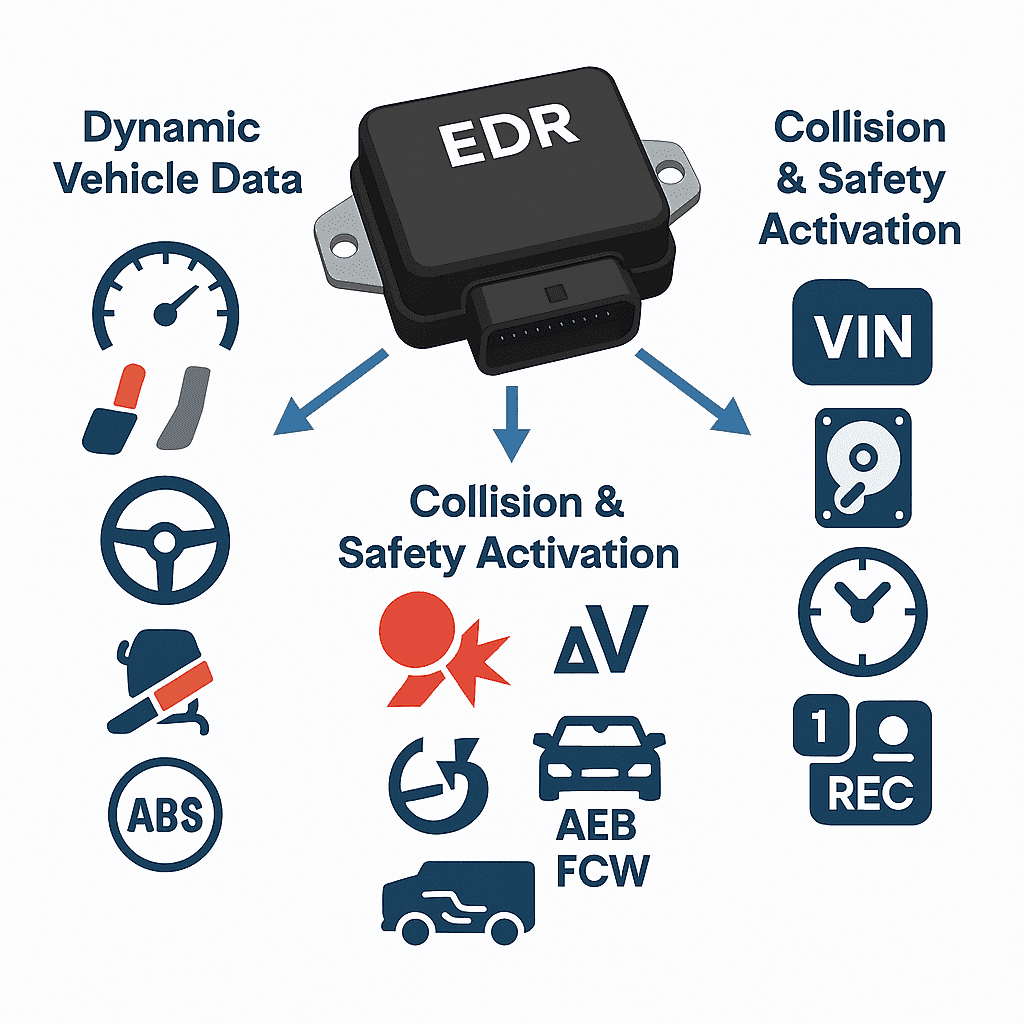
- EDR (Event Data Recorder) — speed, brake force, throttle, seatbelt status, airbag deployment triggers for the pre-crash window
- IVI (In-Vehicle Infotainment) — paired device identifiers (IMEI, IMSI, Bluetooth MAC), call logs, SMS messages synced from paired phones, navigation history, favorite destinations
- Telematics systems — real-time GPS tracking, remote diagnostics, OTA update history
- ECUs (Electronic Control Units) — hundreds of microcontrollers logging engine, transmission, lighting, and sensor data
- OBD-II port data — diagnostic fault codes, performance metrics captured by connected apps
BMW Infotainment Forensics — A 2026 Case Study
Forensic analysis of infotainment systems from four BMW vehicles spanning two generations of technology found that by acquiring and examining data from infotainment hard disks, investigators successfully retrieved valuable forensic artifacts including call logs, text messages, linked smartphone identifiers including Bluetooth, IMEI and IMSI, and other usage traces. Newer NBT EVO systems store a greater volume and variety of forensic artifacts compared to older CIC systems, making them richer sources of digital evidence.
Published in January 2026, this research establishes that vehicle generation matters enormously — newer infotainment platforms are forensically richer, but also more complex to acquire due to proprietary encryption and secure boot implementations.
Table: Connected Vehicle Evidence Sources by System
| Vehicle System | Evidence Type | Forensic Value | Volatility |
|---|---|---|---|
| EDR / Black Box | Speed, braking, crash data | Highest | Low (tamper-evident storage) |
| IVI / Infotainment | Calls, SMS, GPS, paired devices | Very High | Medium |
| Telematics | Real-time location, remote access logs | High | Cloud-dependent |
| OBD-II diagnostic | Fault codes, performance history | Medium | Low |
| CAN bus logs | Inter-ECU communications | High (for cybersecurity incidents) | Very High |
Forensic Collection: The Technical and Legal Minefield
Evidence Volatility and Early Preservation
Vehicle data can be overwritten, corrupted, or lost if a vehicle is powered on or accessed after an incident. Early preservation is critical to maintaining data integrity and forensic value. Proper forensic collection, preservation, and analysis of vehicle digital evidence including infotainment and EDR data ensures accurate, defensible results suitable for expert reporting and testimony.
This is the single most critical procedural fact in automotive forensics. A well-meaning first responder who starts the vehicle to move it from a crash scene may irreversibly overwrite the EDR's pre-crash buffer. Automotive forensic preservation begins at the scene, before the vehicle moves.
Proprietary Architectures and the Standardization Gap
The automotive digital forensics area is still rather immature in part due to the existence of many different platforms and versions. Efforts need to be made to emphasize the security and privacy of modern computerized vehicles.
Unlike smartphones where iOS and Android dominate, the automotive forensic landscape in 2026 spans hundreds of proprietary IVI platforms, dozens of EDR manufacturers, and brand-specific telematics systems — each requiring different acquisition hardware, software, and expertise. There is no universal forensic standard equivalent to UFED for mobile devices.
Pro Tip: Always photograph the instrument cluster, all display screens, and the OBD-II port area before any physical interaction with the vehicle. This establishes a documented pre-acquisition state and protects investigators against claims that forensic access altered the vehicle's data.
Table: Automotive Forensic Acquisition Methods
| Method | Systems Accessed | Technical Complexity | Legal Complexity |
|---|---|---|---|
| OBD-II port extraction | Diagnostic data, some ECU logs | Low | Low |
| IVI hard disk imaging | Full infotainment filesystem | High | Medium |
| EDR specialist tool | Crash data buffer | Medium | Medium |
| CAN bus capture (live) | Real-time ECU communications | Very High | High |
| Telematics cloud extraction | Remote access, GPS history | Medium | High (privacy law) |
Legal Framework and Privacy Considerations
There is no universal standard to collect, examine and analyze data from digital devices on vehicles, drivers, and involved units. The most important factor for admissibility of the report is to verify that the evidence devices have not been altered during the investigation — a framework that enables convenient data collection and analysis, satisfying privacy of the user, is needed.
Connected vehicle investigations intersect with GDPR in EU jurisdictions (telematics data is personal data), state-level privacy laws in the US (California's CCPA applies to vehicle-generated data), and manufacturer data-sharing agreements that determine what telematics data is accessible without a warrant. Pre-establishing legal authority for each data type — EDR, IVI, telematics — before investigation begins is mandatory for admissibility.
Key Takeaways
- Preserve before you move — starting a vehicle post-incident may irreversibly overwrite EDR pre-crash buffer data
- Photograph all displays before any physical forensic interaction to establish documented pre-acquisition state
- Treat IVI as a smartphone surrogate — paired device data, SMS syncs, and call logs may contain evidence unavailable anywhere else
- Use OBD-II extraction as your first acquisition step — it is low-risk, standardized, and yields immediate diagnostic evidence
- Establish legal authority separately for each data type — EDR, IVI, and telematics data each have distinct legal access requirements
- Account for vehicle generation — newer IVI platforms are forensically richer but require platform-specific acquisition expertise
Conclusion
Connected vehicles are the silent witnesses of 2026 — recording behavioral, locational, and communicative data at a granularity that no other evidence source matches. As autonomous driving systems mature and vehicle connectivity deepens, automotive forensics will become one of the most consequential evidence domains across criminal, civil, and insurance investigations. The discipline is still fragmented by proprietary architectures and the absence of universal standards — but the evidence waiting inside every modern vehicle is real, legally admissible when properly collected, and increasingly decisive in investigations where no other evidence survives. Train your investigators on vehicle-class differences. Establish your automotive evidence preservation protocols now. Your next critical evidence source may be sitting in a parking lot.
Frequently Asked Questions
Q: What is automotive forensics and what types of investigations does it support? A: Automotive forensics is the discipline of identifying, collecting, preserving, and analyzing digital evidence from vehicle systems including EDRs, infotainment systems, telematics, and ECUs. It supports accident reconstruction, criminal investigations, insurance fraud detection, and increasingly, cybersecurity breach investigations targeting connected vehicle systems.
Q: What is the most critical evidence preservation rule in automotive forensics? A: Never allow a vehicle to be powered on after an incident before forensic preservation begins. Starting the vehicle can overwrite the EDR's pre-crash data buffer — the most forensically valuable record of the seconds leading up to an accident or incident. Preservation must begin at the scene before the vehicle is moved.
Q: Can investigators access data synced from a suspect's smartphone via the vehicle's infotainment system? A: Yes — and this is one of automotive forensics' most powerful capabilities. When a smartphone pairs with a vehicle's IVI system via Bluetooth or USB, contact lists, call logs, SMS messages, and application data are frequently copied to the vehicle's storage. This data may persist even after the phone itself is wiped, encrypted, or destroyed.
Q: What legal frameworks govern connected vehicle data access? A: GDPR applies to vehicle-generated personal data in EU jurisdictions. California CCPA covers vehicle data for California residents. EDR data access is governed by the Driver Privacy Act in the US, which requires owner consent or a court order. Telematics data held by manufacturers typically requires a legal subpoena or search warrant.
Q: Is there a universal standard for automotive forensic evidence collection? A: No — and this is the discipline's most significant challenge in 2026. Unlike mobile forensics where standards like NIST SP 800-101 Rev. 1 and tools like UFED provide broad coverage, automotive forensics remains fragmented across proprietary platforms. SAE International and ASTM are developing relevant standards, but no universal automotive forensic methodology has been formally adopted.

Enjoyed this article?
Subscribe for more cybersecurity insights.