
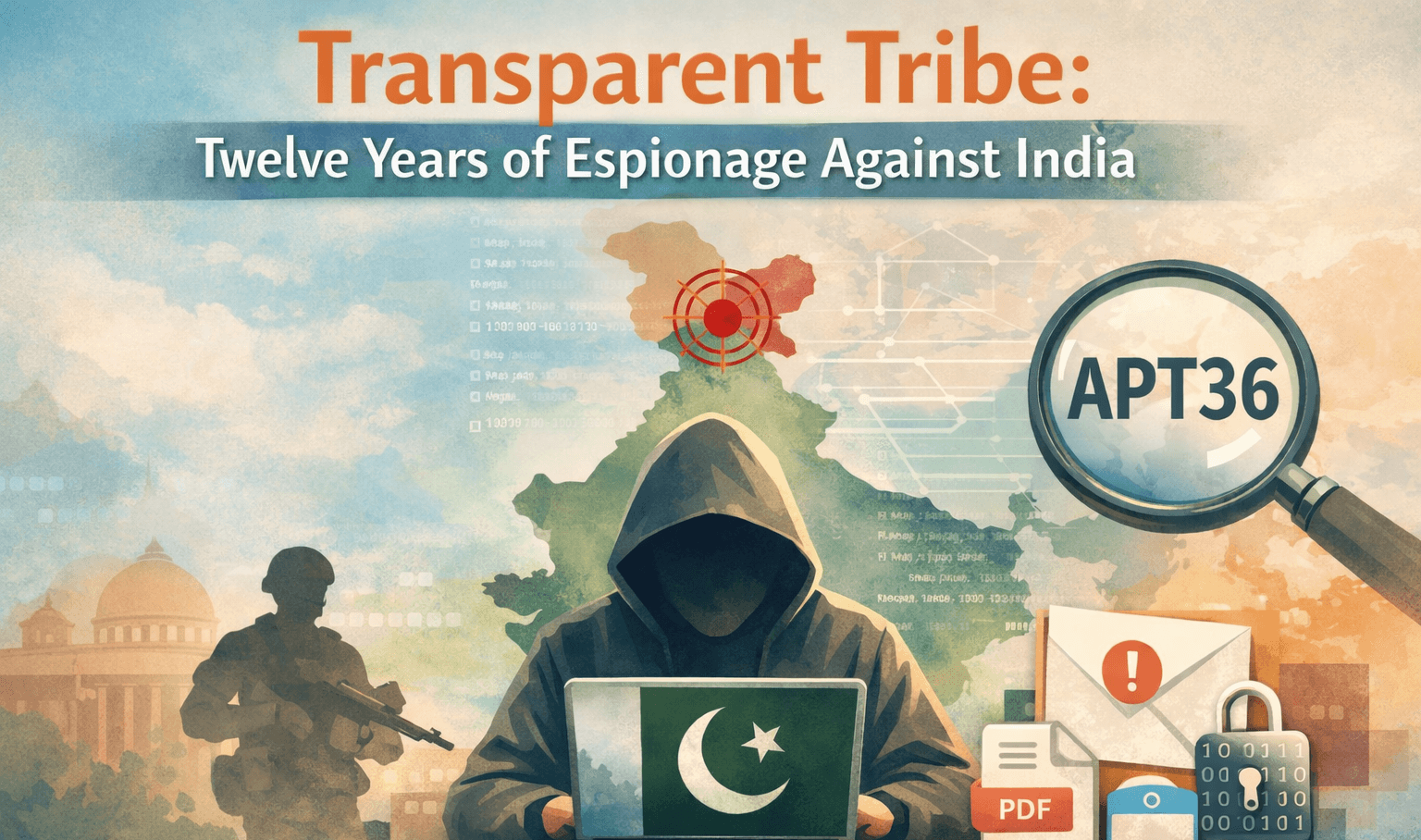
A state-sponsored threat actor has conducted uninterrupted espionage operations against Indian government targets for twelve consecutive years. Transparent Tribe, also known as APT36, has evolved through six distinct remote access trojan generations while maintaining exclusive focus on Indian military, government, and academic institutions. The group's January 2026 campaign introduces antivirus-aware persistence mechanisms that adapt malware behavior based on detected security software—a sophistication level indicating substantial state backing and technical resources.
Security researchers tracking APT36 since 2013 have documented continuous tool development cycles averaging 12-18 months between major updates. The latest campaign deploys weaponized LNK files masquerading as PDF documents from trusted government entities like India's National Council of Educational Research and Training. Once executed, the malware scans for installed antivirus products and selects persistence techniques specifically designed to evade that particular security solution. This adaptive approach represents a significant evolution in APT tradecraft that defenders must understand to implement effective countermeasures.
Understanding State-Sponsored APT Operations
Advanced persistent threat groups backed by nation-states operate with fundamentally different objectives and resources compared to cybercriminal organizations. Financial gain never motivates APT36 campaigns—every operation focuses exclusively on intelligence collection supporting Pakistani strategic interests.
Attribution and Geopolitical Context
Multiple intelligence agencies attribute Transparent Tribe to Pakistani state sponsorship with high confidence. The group's twelve-year operational continuity requires institutional resources that criminal organizations cannot sustain. Infrastructure analysis reveals command-and-control servers hosted within Pakistan IP address ranges, while attack timing correlates directly with India-Pakistan geopolitical tensions.
Target selection provides the strongest attribution indicator. APT36 campaigns exclusively target Indian government ministries, military branches, defense contractors, and academic research institutions. No campaigns have targeted organizations outside India's strategic sphere, demonstrating intelligence collection priorities aligned with Pakistani national security objectives. The Kashmir region receives 35% of targeting focus, reflecting the disputed territory's central role in bilateral tensions.
The Twelve-Year Campaign Evolution
Transparent Tribe operations began in 2013 with relatively unsophisticated spyware deployed through basic phishing campaigns. By 2016, the group had developed Crimson RAT, their first multi-module remote access trojan with comprehensive surveillance capabilities including keystroke logging, screen capture, and audio recording. The malware propagated through USB devices like a worm, demonstrating increasing technical sophistication.
Mobile platform expansion occurred in 2019 with CapraRAT, an Android surveillance tool distributed through fake applications mimicking Kashmir news services. The mobile malware intercepted SMS messages, recorded phone calls, tracked GPS coordinates, and accessed WhatsApp communications. This dual-platform approach allowed APT36 to compromise both desktop systems and mobile devices used by military personnel.
Table: APT36 Malware Evolution Timeline
| Period | Primary Tool | Platform | Key Innovation | Current Status |
|---|---|---|---|---|
| 2013-2016 | Basic Spyware | Windows | Initial operations | Retired |
| 2016-2019 | Crimson RAT | Windows | Multi-module RAT | Retired |
| 2019-2021 | CapraRAT | Android | Mobile surveillance | Active |
| 2021-2023 | ElizaRAT | Windows | Fileless execution | Active |
| 2022-2023 | ObliqueRAT | Windows | Enhanced evasion | Active |
| Aug-Sep 2025 | DeskRAT | Windows/Linux | Golang cross-platform | Active |
| Jan 2026 | New RAT | Windows | AV-aware persistence | Active |
Technical Analysis of Current Attack Methods
The January 2026 campaign demonstrates APT36's continuing evolution in evasion techniques and social engineering sophistication. Understanding the complete attack chain helps security teams identify compromise indicators at each stage.
Weaponized LNK File Delivery
APT36 operators craft malicious LNK shortcut files that appear as legitimate PDF documents through icon manipulation and double extensions. Filenames reference trusted government entities to exploit victim trust relationships. Examples include "NCERT-Whatsapp-Advisory.pdf.lnk" impersonating educational authorities and "PKCERT-Security-Alert.pdf.lnk" mimicking security organizations.
When victims double-click these files, Windows executes the legitimate mshta.exe system binary instead of opening a document. The LNK file contains commands directing mshta.exe to download and execute HTML Application files from attacker-controlled servers. This technique leverages trusted system processes to bypass application whitelisting and behavioral detection mechanisms.
The downloaded HTA file contains VBScript that performs three simultaneous actions: downloading a legitimate decoy PDF document, saving and opening that document to avoid suspicion, and silently downloading the actual malware payload. Victims see the expected document appear while infection occurs invisibly in the background.
Multi-Stage Infection Chain
The malware payload arrives as a DLL file with randomized naming stored in the user's AppData directory. Execution occurs through rundll32.exe, another legitimate Windows system process frequently abused by attackers. The DLL implements a full-featured remote access trojan with capabilities spanning command execution, file exfiltration, keystroke logging, screenshot capture, and system reconnaissance.
Command-and-control communication uses HTTPS encryption to blend with legitimate network traffic. The malware beacons to dns.wmiprovider.com and rotating backup domains every five minutes, transmitting system information encoded in JSON format. CloudFlare content delivery network fronting masks the true server IP address, complicating attribution and takedown efforts.
Data exfiltration occurs during off-hours, typically between 2-6 AM local time when network monitoring receives less attention. The malware compresses and encrypts stolen documents before transmission, reducing bandwidth consumption and avoiding data loss prevention detection signatures.
Antivirus-Aware Adaptive Persistence
The most significant innovation in APT36's current campaign involves detecting installed antivirus software and selecting persistence mechanisms specifically designed to evade that particular product. The malware queries Windows Management Instrumentation for security software details, then implements one of four distinct persistence strategies.
For systems running Kaspersky security products, the malware creates LNK files in the Windows Startup folder pointing to remote HTA payloads. Kaspersky behavioral detection focuses on executable modifications rather than shortcut files, allowing this technique to operate undetected. The HTA execution through mshta.exe appears as legitimate system activity rather than malicious code execution.
Quick Heal users receive a two-stage persistence mechanism combining batch file downloaders with LNK file executors. The batch script downloads the malware DLL from remote servers, while the LNK file executes it through rundll32.exe. This separation confuses behavioral correlation engines that look for direct download-to-execution patterns.
Table: AV-Specific Persistence Mechanisms
| Antivirus Detected | Persistence Method | Evasion Principle | Implementation Complexity |
|---|---|---|---|
| Kaspersky | LNK + Remote HTA | Shortcut files receive lower scrutiny | Low |
| Quick Heal | Batch + LNK combo | Multi-stage breaks correlation | Medium |
| Avast/AVG/Avira | Direct Startup DLL | Whitelisted rundll32 execution | Low |
| No AV Detected | Registry + Scheduled Task | Maximum redundancy | High |
Target Selection and Intelligence Objectives
APT36 demonstrates sophisticated understanding of Indian government structure and military organization through precise target selection. Campaign themes reference current policy issues and operational concerns relevant to specific victim demographics.
Primary Target Categories
Indian Ministry of Defence receives highest priority targeting, accounting for 40% of documented campaigns. Phishing emails impersonate internal communications, reference classified-appearing content, and time attacks during budget sessions or policy announcements. The goal involves accessing military readiness assessments, equipment procurement plans, troop deployment schedules, and research project documentation.
Academic institutions focusing on defense-adjacent research constitute 20% of APT36 targeting. Universities developing nuclear technology, aerospace engineering, cybersecurity research, and artificial intelligence applications receive persistent attention. Compromising principal investigators provides access to cutting-edge research before publication, granting Pakistani intelligence services strategic technology insights.
The Kashmir region represents 35% of geographic targeting concentration. Border Security Force personnel, local government officials, and journalists operating in the disputed territory all face elevated risk. Intelligence collected from Kashmir targets informs Pakistani assessments of Indian military posture and policy positions regarding the territorial dispute.
Social Engineering Sophistication
Campaign lure documents demonstrate deep understanding of Indian bureaucratic culture and communication patterns. The December 2025 "NCERT WhatsApp Advisory" campaign targeted educators by impersonating a trusted government educational authority issuing mandatory security guidance. The urgent tone and official formatting convinced recipients to open malicious attachments despite security training.
Another campaign impersonated Pakistan Computer Emergency Response Team issuing cross-border security alerts about vulnerabilities affecting Indian networks. This approach exploited targets' professional responsibility to investigate security warnings while using the appearance of international cooperation to lower suspicion. The psychological manipulation reveals sophisticated social engineering capabilities beyond typical phishing operations.
Defensive Strategies and Detection Methods
Organizations facing APT36 threats must implement layered defenses addressing email security, endpoint protection, and network monitoring. No single control provides complete protection against state-sponsored adversaries with twelve years of operational experience.
Email Gateway Controls
Blocking LNK file attachments organization-wide eliminates the primary delivery vector for current APT36 campaigns. Email security gateways should quarantine messages containing .lnk extensions and alert security teams for investigation. Double extension detection identifying patterns like .pdf.lnk or .docx.lnk provides additional protection against icon manipulation techniques.
Sender verification through SPF, DKIM, and DMARC enforcement prevents email spoofing of government domains. External sender warnings help recipients identify messages originating outside their organization. URL analysis filtering should block downloads from newly registered domains less than 90 days old, as APT36 rotates infrastructure regularly.
Deploying email sandboxing technology provides dynamic analysis of attachments before delivery. Sandboxes execute suspicious files in isolated environments, observing behavior and identifying malicious activity patterns. Organizations should configure sandboxes to detonate LNK files and follow redirect chains to remote HTA payloads.
Endpoint Hardening Measures
Application whitelisting policies blocking mshta.exe execution from untrusted sources prevent weaponized LNK files from downloading HTA payloads. Similarly, restricting rundll32.exe from executing DLLs located in user AppData directories stops the core malware payload from running. These controls leverage Windows AppLocker or equivalent enterprise application control platforms.
PowerShell logging captures all script execution for forensic analysis and threat hunting. Organizations should enable both script block logging and transcription features, sending logs to security information and event management systems for correlation and alerting. This visibility helps detect suspicious PowerShell usage in APT36 infection chains.
Deploying endpoint detection and response solutions provides behavioral monitoring beyond signature-based antivirus. EDR platforms identify unusual process execution trees, detect credential access attempts, and alert on suspicious network connections. APT36's adaptive persistence mechanisms specifically target traditional antivirus, making EDR capabilities increasingly essential.
Table: Defense-in-Depth Implementation Priority
| Control Type | Implementation Timeframe | Difficulty | Effectiveness | Cost |
|---|---|---|---|---|
| Block LNK attachments | Immediate (hours) | Low | High | Low |
| Application whitelisting | 1-2 weeks | Medium | Very High | Medium |
| PowerShell logging | Days | Low | Medium | Low |
| EDR deployment | 2-4 weeks | High | Very High | High |
| Email sandboxing | 1-2 weeks | Medium | High | Medium |
| Network monitoring | 1-4 weeks | Medium | Medium | Medium |
Key Takeaways
- APT36 has conducted continuous espionage against Indian targets for twelve years, indicating substantial Pakistani state sponsorship and institutional resources
- The January 2026 campaign deploys antivirus-aware persistence mechanisms that adapt malware behavior based on detected security software, representing significant tradecraft evolution
- Weaponized LNK files masquerading as PDF documents from trusted government entities bypass traditional email security and exploit user trust relationships
- Exclusive targeting of Indian government, military, and academic institutions with zero financial motivation confirms pure intelligence collection objectives aligned with Pakistani strategic interests
- Multi-stage infection chains leverage legitimate Windows system processes like mshta.exe and rundll32.exe to evade application whitelisting and behavioral detection
- Organizations must implement layered defenses including LNK file blocking, application whitelisting, PowerShell logging, and endpoint detection and response solutions
- Social engineering sophistication demonstrates deep understanding of Indian bureaucratic culture, requiring security awareness training addressing government-themed lure documents
Conclusion
Transparent Tribe's twelve-year operational continuity demonstrates the persistent threat posed by well-resourced state-sponsored adversaries. The group's evolution through six distinct malware generations while maintaining exclusive focus on Indian targets reveals strategic patience and substantial technical investment. Organizations within APT36's targeting scope face an adversary that continuously adapts tactics to bypass emerging defenses.
The antivirus-aware persistence innovation in January 2026 campaigns signals that APT groups are actively studying defensive security tools to develop targeted evasion techniques. This arms race requires defenders to move beyond signature-based detection toward behavioral analytics and threat hunting methodologies. Implementing defense-in-depth architectures with multiple overlapping controls provides the best protection against sophisticated adversaries.
Security teams should begin by blocking LNK file attachments and deploying application whitelisting policies to prevent current attack vectors. Enabling comprehensive PowerShell logging and implementing EDR solutions provides visibility into compromise attempts. Regular security awareness training addressing government-themed social engineering helps users recognize and report suspicious communications before clicking malicious links.
Frequently Asked Questions
Q: How can organizations determine if they have been compromised by APT36?
A: Search for indicators including unexpected LNK files in Startup folders, registry Run keys with suspicious rundll32 executions from AppData, and network connections to dns.wmiprovider.com or similar CloudFlare-fronted domains. Review PowerShell logs for Invoke-WebRequest commands downloading DLLs, and check for mshta.exe processes executing with remote URL arguments. Conduct forensic analysis of systems accessing classified information within the past 24-36 months.
Q: Why does APT36 exclusively target Indian organizations rather than diversifying geographically?
A: State-sponsored APT groups operate according to national intelligence priorities defined by sponsoring governments. Pakistani intelligence services focus resources on understanding Indian military capabilities, government policy positions, and strategic research initiatives due to ongoing bilateral tensions and territorial disputes. Geographic exclusivity confirms attribution while demonstrating resource constraints that prevent global operations like Chinese APT groups conduct.
Q: What makes the antivirus-aware persistence mechanism particularly dangerous?
A: Traditional malware uses identical persistence techniques regardless of victim environment, allowing antivirus vendors to develop generic detection signatures. APT36's adaptive approach selects evasion techniques specifically designed for each security product, requiring defenders to understand four distinct persistence methods simultaneously. This sophistication indicates extensive testing infrastructure where attackers evaluate their malware against popular antivirus solutions before deployment.
Q: Should organizations block all email attachments to prevent APT36 compromises?
A: Complete attachment blocking creates operational challenges that may not be proportional to risk for most organizations. Instead, block specific high-risk file types like LNK, HTA, and executable extensions while deploying sandboxing for remaining attachment types. Implement user security awareness training to recognize government-themed social engineering attempts. Organizations handling classified information should consider more restrictive policies requiring manual security team approval for certain attachment categories.
Q: How should incident response teams handle suspected APT36 compromises?
A: Immediately isolate affected systems from the network while preserving forensic evidence through memory dumps and disk images. Search for lateral movement indicators including unusual remote desktop connections, credential theft attempts, and data staging in temporary directories. Rotate all credentials that potentially compromised systems could access, particularly those granting access to classified networks. Engage specialized incident response firms with APT investigation experience, as state-sponsored threats require different containment approaches than typical malware incidents.

Enjoyed this article?
Subscribe for more cybersecurity insights.