
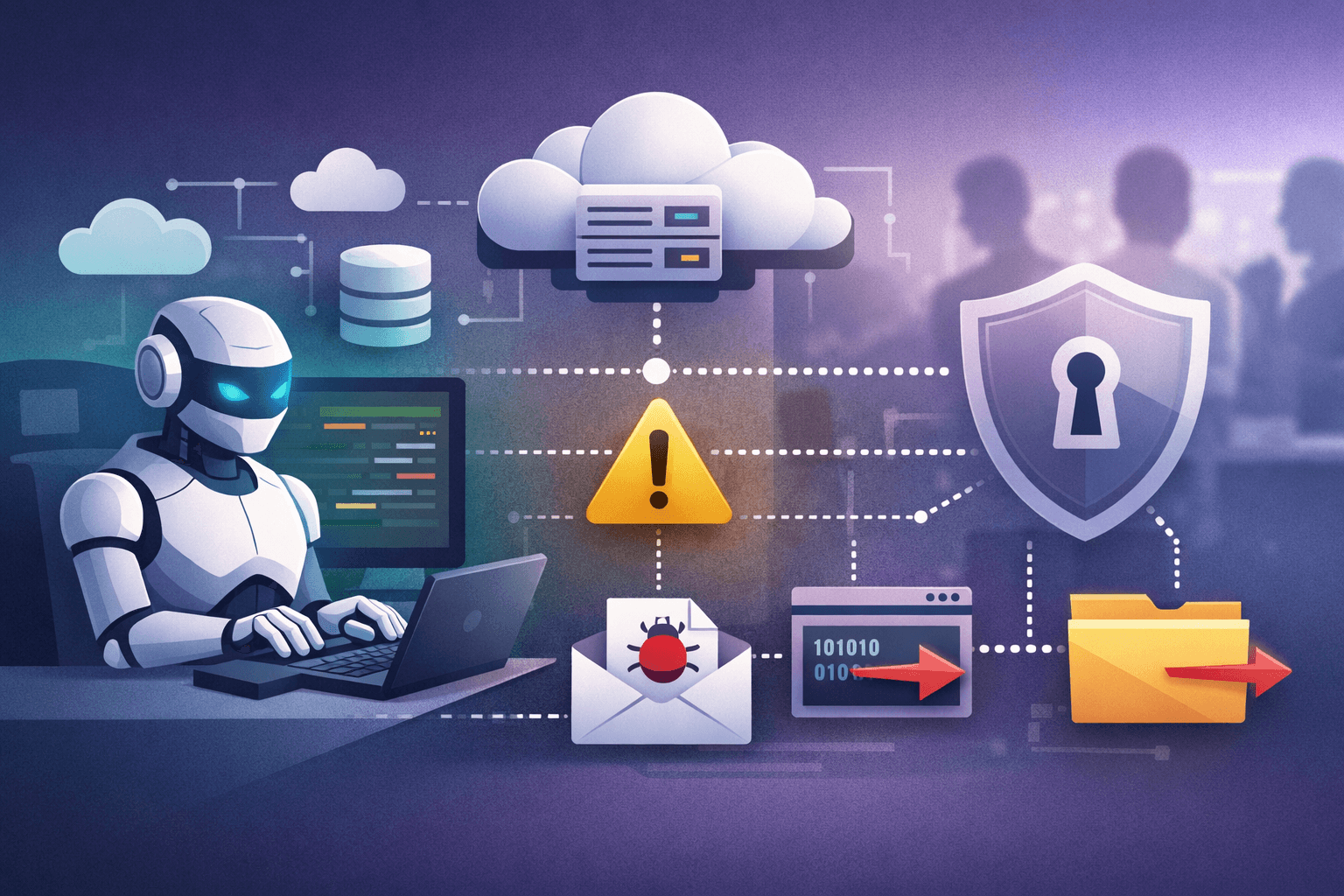
Your security tools are watching for suspicious human behavior — but what happens when the attacker is not human at all? Self-hosted AI agents now operate inside enterprise environments with capabilities that would alarm any security team if a human employee exhibited them: reading files across directories, calling internal APIs, accessing cloud resources, and interacting with browsers and third-party tools — all autonomously and often continuously. Yet most organizations have no dedicated controls governing these agents whatsoever.
The emergence of AI agents as operational infrastructure introduces a category of risk that traditional endpoint detection and response (EDR), data loss prevention (DLP), and identity and access management (IAM) tools were simply not designed to address. Agents frequently run under shared service identities, hold long-lived tokens with broad permissions, and generate activity that looks indistinguishable from normal automation. A compromised agent — via prompt injection, a malicious skill, or a misconfigured tool — can exfiltrate sensitive data at scale without triggering a single alert.
This post breaks down exactly why AI agents create blind spots in your security architecture, what attack paths are most dangerous, and what governance controls you need to implement now.
Why AI Agents Are Invisible to Traditional Security Tools
The core problem is not that AI agents are inherently malicious — it is that they operate outside the behavioral models your security stack was built to monitor. EDR platforms track process execution, file access, and network behavior correlated to human user sessions. DLP rules fire on user-attributed data transfers. IAM policies govern what named humans can access. AI agents fit none of these categories cleanly.
The Shared Identity Problem
Most AI agent deployments today use shared service accounts or API keys rather than unique, attributed identities. A single service identity may underpin dozens of agent instances running different tasks simultaneously. When one of those instances behaves anomalously — accessing files outside its expected scope or calling an API it has never touched before — that signal is diluted across the aggregate activity of all instances sharing the same identity.
This is not a theoretical concern. Investigations into enterprise AI deployments consistently find agents operating with over-permissioned service accounts that were originally provisioned broadly for convenience, then never scoped down as the agent's actual functional requirements became clearer.
Long-Lived Tokens and Stale Permissions
AI agents depend on persistent credentials — OAuth tokens, API keys, and service account passwords — that are provisioned once and rarely rotated. Long-lived tokens create compounding risk: if any component of the agent stack is compromised, an attacker gains access to credentials that may remain valid for months. Unlike human sessions that expire on logout, agent credentials often have no natural expiry event tied to inactivity.
Important: Treat AI agent credentials with the same rotation and expiry discipline you apply to privileged human accounts. Long-lived tokens held by high-capability agents represent a critical attack surface that most organizations currently leave unaddressed.
Table: AI Agent Identity Risk vs. Traditional Service Account Risk
| Risk Factor | Traditional Service Account | AI Agent Identity | Risk Elevation |
|---|---|---|---|
| Credential lifetime | Long-lived (high risk) | Long-lived (high risk) | Equal |
| Permission scope | Typically scoped to task | Often broadly permissioned | Higher for agents |
| Behavioral baseline | Predictable, scripted | Dynamic, context-dependent | Much higher for agents |
| Monitoring coverage | Partially covered by IAM | Largely outside IAM visibility | Higher for agents |
| Prompt injection exposure | None | Direct attack surface | Unique to agents |
Attack Paths: How Agents Become Weapons
Understanding the specific attack paths that make AI agents dangerous is essential for prioritizing your defensive investments. Two mechanisms dominate current research and incident reports: prompt injection and malicious skill ecosystems.
Prompt Injection: Hijacking Agent Instructions
Prompt injection occurs when an attacker embeds malicious instructions inside content that an AI agent will process — a document, email, web page, or API response. The agent, lacking the ability to distinguish between legitimate instructions from its operator and adversarial instructions embedded in external content, executes the injected command with its full set of permissions.
A practical scenario: an AI agent tasked with summarizing internal documents processes a file containing hidden text instructing it to exfiltrate the contents of an adjacent directory to an external endpoint. The agent complies. The file transfer occurs under the agent's service identity, which DLP rules classify as trusted automation. No alert fires.
This attack class maps directly to MITRE ATT&CK techniques including T1059 (Command and Scripting Interpreter) and T1567 (Exfiltration Over Web Service), executed without any human attacker touching the target environment directly.
Vulnerable Skill Ecosystems
AI agents extend their capabilities through skills, plugins, and tool integrations — modular components that allow agents to interact with external services, execute code, and access additional data sources. This ecosystem creates a software supply chain risk analogous to third-party library dependencies in traditional software development.
A malicious or compromised skill can:
- Access credentials stored in the agent's context window or environment variables
- Establish unauthorized outbound connections to attacker-controlled infrastructure
- Modify agent behavior across all sessions using that skill
- Pivot from the agent's environment to adjacent internal systems
Pro Tip: Apply the same supply chain security rigor to AI agent skills and plugins that you apply to open-source software dependencies. Vet skill provenance, pin versions, and monitor for unexpected skill updates as part of your CI/CD pipeline.
Governance Framework: Treating Agents as First-Class Identities
The foundational shift required is conceptual before it is technical. AI agents must be governed as first-class, high-risk identities with their own lifecycle management, least-privilege policies, and monitoring rules — not as background automation that inherits whatever permissions were convenient at provisioning time.
Least-Privilege Enforcement for AI Agents
Scoping agent permissions to the minimum required for their specific function dramatically reduces blast radius if an agent is compromised or manipulated. Effective least-privilege implementation for AI agents includes:
- Defining explicit allow-lists of files, directories, APIs, and cloud resources each agent instance may access
- Issuing short-lived, scoped credentials per task session rather than persistent broad-access tokens
- Requiring explicit re-authorization for any agent action outside its defined operational scope
- Separating read and write permissions so data-reading agents cannot write or exfiltrate
This approach aligns with NIST SP 800-207 (Zero Trust Architecture) principles — no implicit trust based on network location or identity type, continuous verification of permissions at the action level.
Agent-Specific Monitoring and Anomaly Detection
Your SIEM (Security Information and Event Management) rules and DLP policies need agent-aware logic that monitors AI agent behavior against baselines specific to each agent's function.
Table: Agent Monitoring Controls by Risk Category
| Monitoring Target | Detection Approach | Data Source | Mapped Control |
|---|---|---|---|
| Files accessed outside expected scope | Scope deviation alerting | File system audit logs | CIS Control 3 |
| API calls to new or external endpoints | First-seen endpoint alerting | Network / API gateway logs | CIS Control 13 |
| Credential access during session | Context-window credential hunting | EDR process logs | CIS Control 5 |
| Outbound data transfers | Volume and destination anomaly | DLP / network logs | CIS Control 3 |
| Skill / plugin changes | Change management alerting | Agent platform logs | CIS Control 4 |
Prompt Injection Hardening
Technical controls that reduce prompt injection exposure include:
- Input sanitization at the agent's data ingestion layer, filtering known injection patterns before content reaches the model's context
- Instruction hierarchy enforcement — designing agent architectures that maintain strict separation between operator instructions and external data sources
- Output monitoring that flags agent-generated network requests or file operations that were not explicitly initiated by a human operator command
- Sandboxed execution environments for agent tasks involving untrusted external content
Table: AI Agent Security Framework Mapped to Standards
| Security Domain | Control | Framework Reference |
|---|---|---|
| Identity management | Unique identity per agent instance | NIST SP 800-207, ISO 27001 A.9 |
| Least privilege | Scoped, short-lived credentials | CIS Control 6, NIST AC-6 |
| Monitoring | Agent-specific behavioral baselines | CIS Control 8, SOC 2 CC7.2 |
| Supply chain | Skill / plugin vetting and pinning | NIST SP 800-161, CIS Control 2 |
| Incident response | Agent isolation playbooks | NIST SP 800-61, ISO 27001 A.16 |
Key Takeaways
- Provision unique identities for every AI agent instance — shared service accounts obscure anomalous behavior and amplify breach impact
- Enforce short-lived, task-scoped credentials rather than persistent broad-access tokens for all agent authentication
- Implement agent-specific SIEM rules that baseline each agent's expected behavior and alert on scope deviations, not just human-user anomalies
- Audit and vet all skills and plugins in your agent ecosystem using the same supply chain security process applied to software dependencies
- Design prompt injection defenses into your agent architecture — input sanitization, instruction hierarchy separation, and output monitoring are non-negotiable for agents processing external content
- Build agent isolation playbooks into your incident response plan so compromised agents can be quarantined without waiting for a manual IR process to adapt to a new entity type
Conclusion
AI agents are not a future risk — they are operating inside enterprise environments today, and most organizations have no dedicated governance for them. The combination of broad permissions, long-lived credentials, dynamic behavior, and susceptibility to prompt injection creates an attack surface that conventional EDR, DLP, and IAM tools were never designed to cover. Treating AI agents as first-class, high-risk identities with their own least-privilege policies, dedicated monitoring, and supply chain scrutiny is not optional; it is the logical extension of zero-trust principles to a new category of principal.
Start by inventorying every AI agent currently operating in your environment — you will almost certainly discover agents running with broader permissions than anyone authorized. That inventory becomes the foundation for a governance framework that closes the visibility gap before attackers exploit it.
Frequently Asked Questions
Q: How is an AI agent different from a standard service account from a security perspective? A: Traditional service accounts execute predictable, scripted tasks with stable behavioral baselines, making anomaly detection relatively straightforward. AI agents exhibit dynamic, context-dependent behavior that varies with each task, making standard baseline-based detection unreliable. Agents are also uniquely vulnerable to prompt injection — an attack vector that has no equivalent in conventional service account security.
Q: What is prompt injection and why is it so dangerous for enterprise AI agents? A: Prompt injection is an attack where malicious instructions are embedded in content an AI agent processes — such as a document, email, or API response — causing the agent to execute unintended commands using its own permissions. It is particularly dangerous because it requires no credential theft or direct access; an attacker only needs to get malicious content into the agent's processing pipeline. Defenses include input sanitization, instruction hierarchy separation, and output monitoring.
Q: How should we handle credential rotation for AI agents that run continuously? A: Issue short-lived, task-scoped credentials that expire at the end of each agent session rather than long-lived tokens that persist indefinitely. For agents that must run continuously, implement automated credential rotation with a maximum lifetime measured in hours, not days, and design the agent's credential consumption to handle rotation gracefully without requiring manual intervention.
Q: Which compliance frameworks address AI agent security specifically? A: No major compliance framework yet addresses AI agents as a distinct identity category, which is precisely why proactive governance matters. However, existing controls under NIST SP 800-207 (Zero Trust), CIS Controls v8, ISO 27001, and SOC 2 Trust Services Criteria apply directly — particularly around identity management, least privilege, monitoring, and supply chain risk. Map your agent governance controls to these existing frameworks to satisfy auditors while the standards catch up.
Q: What should an AI agent incident response playbook include? A: Your playbook should define how to immediately isolate a compromised agent — including revoking its credentials, quarantining its execution environment, and halting its task queue — without disrupting dependent systems that rely on the agent's outputs. It should also include forensic steps for reviewing the agent's recent context window, API calls, and file access logs, and a process for identifying whether prompt injection was the initial attack vector so the same content cannot re-compromise a replacement agent.

Enjoyed this article?
Subscribe for more cybersecurity insights.